
بِسْمِ ٱللّٰهِ ٱلرَّحْمٰنِ ٱلرَّحِيمِ
Contents of this post:
Two leaders of one group: is it possible?
Pairs of Prophets
“O son of my mother! Please don’t pull my beard and my head!”
Prophets – Uncle and nephew
So-called, modern-day Alpha, Beta, Omega, Delta & Sigma personalities
Cities that “lead” a country
The “Baniya’s” of pre-partition India
The Memons and me – a long history
My family connection with the Memons of Karachi
A glass of Coca Cola, a bar of Lindt chocolate, over-priced Mövenpick ice cream and Tim Hortons coffee
Spiritual “LaunchGood” for my mother
Conclusion
******
A lot is said and written about leadership, particularly nowadays, as humankind endures (and adjusts to) the all-encompassing effects of the pervasive digital (technological) revolution.
There are the textbooks with official citations and references that put forward theories about leadership – these theories are mostly taught at academic institutions. Then there are real-life (current or past) events that happen as a result of decisions made by those human beings who occupy leadership positions (whether deserved or undeserved). This is called history (in the making). Then there are the professional studies undertaken by qualified scientists, policymakers, and “think tanks”, which publish (and present) their reports and findings as seminars, papers and journals.
And then, there is everyone’s personal life experience.
Whatever the case, a lot is said and written about leadership – like I said.
The above sources of information are, for me, secondary. I endeavor to glean knowledge and information about any concept or theory primarily from what is my personal go-to source: the words of Allah – the Glorious Qur’an.
However, whatever I learn from the Qur’an, I try to use that knowledge as the criterion (فرقان), the guideline (هدًى) and the light (النور) with which I gauge, perceive and analyze whatever is happening in the world, especially when I come across information from (the aforementioned) secondary sources.
Two leaders of one group: is it possible?
One thing that has been debated by people is whether it is possible to have more than one leader of one group.
When I was a Taleem Al-Qur’an student at Al-Huda back in 2000–2001, my Qur’an teacher (Dr Farhat Naseem Hashmi) was of the opinion that this is not possible.
She mentioned this when teaching us about the absolute leadership of the man (i.e. the husband) in a Muslim marriage, and why only the male (the husband) has been appointed as the leader (قوَّام) in the relationship.
We are not talking about the sub-leaders or the “lieutenants” here (who are the leader’s next-in-command, as I will discuss further below). Every leader needs, and has, those.
We are talking about having two leaders of one group, who have an equal portion of the authority and power over that group.
Is this possible?
When I came across stories in the Qur’an that mentioned more than one Prophet of Allah living in the world at the same time, I got thinking rather deeply about this.
Also, in the aftermath of how the world is changing, with women now being expected (if not outright coerced, cornered, manipulated, or forced by circumstance) to take on positions of leadership, I got more and more involved in reading up about what makes a leader, and the why and how of when anyone becomes a leader.
The jarring circumstances of my personal life during the past few years have also made me think about what a “leadership crisis” is, and how it comes about when the leader of a group dies, becomes incapacitated, or absconds their position, without first finding, appointing, and training a vicegerent to inherit that vacant position, once they have left it.
So I wonder…
Can leadership qualities be acquired and nurtured?
Or is a person born with them?
Does hardship and calamity force someone to become a leader, even when they do not want to?
And lastly, what happens when a leader fails to appoint an appropriate successor?
Pairs of Prophets
In the Qur’an, like I said above, what I find interesting is that there is mention of pairs of Prophets who existed during the same lifetime.
Interestingly, the Qur’an also describes how some of these Prophets, during the life-changing calamities that came their way, sought the help, refuge, knowledge, or mentorship of older sages, either in the nations in which they were born, or those who dwelled elsewhere, once they had to flee the nations that they were born into, to safeguard their lives or their faith (or both).
This indicates that, assuming for a minute that the concept of “the Alpha male” is, in fact, applicable to human beings, then this Alpha male does need the mentorship, guidance, and help of older, in-the-background (viz. behind-the-scenes, away from the limelight) kind of wise elders, – in order to reach their full potential once they are ready to take on the heavy responsibility of leadership.
This is precisely what the Qur’an has described, in the form of real-life stories, often repeated in different surah’s.
The first example that comes to my mind is that of Prophet Moosa and his brother Haroon (عَلَيهِمُا السَّلَام).
The second example is that of Prophet Ibrahim and Prophet Lut (عَلَيهِمُا السَّلَام).
And then, of course, there are several examples of the mention of father-son prophetic duos in the Qur’an, such as Prophet Yaqoob and Prophet Yusuf, Prophet Ibrahim and Prophet Ismail, and Prophet Dawood and Prophet Sulaiman (عَلَيهِمُ السَّلَام).
Anyhow, when Prophet Moosa was granted Prophethood by Allah and tasked to go to Pharaoh to invite him to accept him as a Prophet and to release the slave tribe of Bani Israel, Prophet Moosa asked Allah to let his brother Haroon become his helper [28:34].
وَأَخِى هَـٰرُونُ هُوَ أَفْصَحُ مِنِّى لِسَانًۭا فَأَرْسِلْهُ مَعِىَ رِدْءًۭا يُصَدِّقُنِىٓ ۖ إِنِّىٓ أَخَافُ أَن يُكَذِّبُونِ
“And my brother Aaron is more eloquent than I, so send him with me as a helper to support what I say, for I truly fear they may reject me.”
The Arabic words used to refer to the role that his older brother Haroon was to play in assisting him in his mission of Prophethood, were: رِدْءًا يُصَدِّقُنِىٓ and a third word found in وَزِيرًا – [25:35].
These words carry the meanings of: someone who helps or supports (رِدْءًا), reinforces or verifies the truth of (صَدَّقَ), and shares the burden of/with (وزر).
So, even though Prophet Moosa was officially appointed as the main leader by Allah, he requested his older brother Haroon as an aide and helper in his mission.
In his request, Prophet Moosa also mentioned the quality of Prophet Haroon as being more well-spoken than him (هُوَ أَفْصَحُ مِنِّى لِسَانًا), as one of the reasons for wanting his aid.
This proves 3 things. First, that age and experience should not always be taken as the main factors in granting leadership.
Meaning, someone who is younger and less experienced can be more able as a leader. Shout-out to those culturally rigid Pakistani elders who tend to grant leadership to their offspring mostly on the basis of age (the oldest son gets passed the baton of patriarchal family authority, even if a younger son, or daughter, is more capable of it).
The second thing is that if the main leader is lacking in a particular quality, his or her lieutenant or aide who possesses that quality, can make up for it.
The third thing is that true leaders do not shy away from accepting that one or more of their helpers possesses a certain quality at a better level than they do.
“Alpha” leaders are self-aware and humble enough to identify and embrace their shortcomings and ask for help.
“O son of my mother! Please don’t pull my beard and my head!”
As a person who is the younger one of two siblings who are “Irish twins” (born a year apart), I have had my fair share of sibling fights during my childhood. It is interesting for me to note the reaction of Prophet Moosa when he saw the freed Bani Israel worshiping the idol of the calf (fashioned from gold by the misguided Samiriyy).
When it comes to observing the way these two brothers, Moosa and Haroon, handled this trial of their leadership (the trial of Samiriy and the golden idol of the calf), there are important lessons for us regarding how to handle the delegation of duties, accountability of actions, forbearance in order to prevent dissension, and retribution of crime.
Prophet Moosa had left his brother Haroon to watch over the Bani Israel in his absence, when he went to receive the Torah from Allah in physical form. On his return, when he found out that the Bani Israel had acquired an idol of a calf that they were worshipping, he was shocked and aghast.
That was when he questioned his brother Haroon about this, grabbing his brother’s beard and head in the process.
قَالَ يَبْنَؤُمَّ لَا تَأْخُذْ بِلِحْيَتِى وَلَا بِرَأْسِىٓ إِنِّى خَشِيتُ أَن تَقُولَ فَرَّقْتَ بَيْنَ بَنِىٓ إِسْرَٰٓءِيلَ وَلَمْ تَرْقُبْ قَوْلِى
“Aaron pleaded, “O son of my mother! Do not seize me by my beard or the hair of my head. I really feared that you would say, ‘You have caused division among the Children of Israel, and did not observe my word.’” [20:94]
From this we learn that when a leader who has been appointed by, and answerable to, none other than Allah, his Creator, – finds things going awry after his back is turned, especially when it involves a major sin that incurs the wrath of Allah, then his taking stern and outwardly ‘harsh’ stock of things is completely warranted and justified.
Prophets – uncle and nephew
Now we come to the duo of Prophet Ibrahim and his nephew, Prophet Lut (عَلَيهِما السَّلَام). It is said that when Prophet Ibrahim started preaching, no one believed in his message except his wife Sarah and his nephew Lut.
They were, in fact, severely persecuted because of their faith. Although, in my experience, Pakistani Islamic preachers and scholars do not frequently bring up or dwell upon the role that Azar had to play in trying to lynch his own son. They focus more on how Allah transformed the fire into which Azar and others threw the young Ibrahim, into cold petals, not on the issue of how a father could actively try to murder his own son… (which, by the way, is not a rare occurrence in the history of mankind, or in Pakistan, for that matter.. throughout history, there have been instances of parents deliberately killing, starving, selling off, mistreating, throwing out of the house, or oppressing their young children, – it is a fact).
Prophet Ibrahim and the new convert, Lut, emigrated to be able to practice their faith openly.
Qatadah said, “They migrated together from Kutha, which is on the outskirts of Kufa, and went to Syria.” [Tafsir Ibn Kathir] Thenceforth, Lut was granted Prophethood and tasked with going to the people of Sodom on a Divine mission. He settled in Sodom.
As you can see, these two Prophets lived on earth during the same lifetime, but Allah chose for the main domain of the younger one to be another nation, and unlike Prophets Moosa and Haroon, who shared the same mission and nation to preach to, Allah separated the uncle and nephew duo of Ibrahim and Lut, physically.
It is, therefore, sometimes better for two leaders (both of whom classify as ‘Alpha’, as I will elaborate further below) to have completely separate (viz. physically far apart) domains and spheres of activity, even if they are both related by blood, on good terms with each other, similar in their faith and mission, and appointed by the same authority (i.e. their Creator, Allah).
Sometimes, it is just better for two Alpha’s to work apart – away from each other.
So-called, modern-day Alpha, Beta, Omega, Delta & Sigma personalities
Highly criticized by scientists but gaining momentum nevertheless, is the modern day theory about what is referred to, in slang, as “the Alpha male”. It is based on a study carried out on a pack of wolves, in which “the alpha of the pack” was identified based on his distinguishing behaviors.
Since then, many scientists are protesting the validity of the growing trend of applying the results of this study that was carried out on wolf behaviors to human beings, to little effect.
No matter how many people rubbish the theory of “the Alpha male vs the Beta male” and the “the Omega female vs the Sigma female”, the younger generation of today, which comprises of over 50% of the world population already, is rushing to take online (free and paid) personality tests, quizzes and assessments, in order to find out what personality type they are.
As with any business, the self-help (online content) industry has identified the opportunities offered by this trend, to produce chunks upon chunks of articles and videos related to this concept.
Also, the concept of “the Alpha male” is increasingly being associated with identifying and helping the next big CEO of any business organization to better achieve the goals of the latter.
Finding a leader for a group, who will effectively achieve its objectives and vision in the long-term…. is not easy.
Helping that leader (in any way that is needed) to make sure that they stay in the role of leadership, without giving up and walking off, is even more difficult.
And, finally (in case a suitable leader is found and the group goes on to achieve its goals successfully), when that leader eventually passes away, or otherwise becomes incapacitated/redundant, finding an able successor or vicegerent who will be able to carry on his or her legacy is … perhaps,… the hardest part of all.
Cities that “lead” a country
Every region, state, province and country has that one city.
You know, the hustling and bustling, overcrowded hub of business activity. The center of commerce, trade, industry, progress and development, which the masses from smaller towns flock to in search of livelihoods and careers.
Usually, because of its business activities, this “Alpha” city also tends to attract its fair share of crime and chaos.
We all know (or can safely guess) which city of Pakistan that is. If Pakistan’s cities were to be ranked according to “Alpha-ness”, it would probably come out as the numero uno. What Paris is to France, London is to Britain, New York is to USA, and Sydney is to Australia, the over-populated and chaotic city of Karachi is to Pakistan.
Now, before I go on, I need you to refer quickly to some history of this region in which Allah decreed for me to be born:
“To say that Pakistan’s economy was dominated by 22 families in the Ayub era and is now dominated by 31 families – as most news coverage of this study have done – is to imply that the club of 22 remained intact and grew slightly larger. Nothing could be further from the truth.
Only five of the original 22 families – the Habibs, the Dawoods, the Saigols, the Babar Ali family, and the Bhimjees – are part of this club of 31 families in the current era. The rest of the 22 families are not exactly poor, but today their descendants tend to be on the upper end of upper middle class rather than the wealthy captains of industry that they were in the 1960s.
The rest of the 31, on the other hand, are those who were upper middle class in the 1960s – or even lower in some cases – and rose up through either entrepreneurial ambition, or proximity to powerful politicians, or both. This is very important to note because what it means is that wealth in Pakistan is not something static that simply gets passed down from generation to generation, and that some can rise while others can fall.”
[Profit Magazine – Who Owns Pakistan?]
When it comes to the few cities of Pakistan, yes, Karachi does outwardly seem to be the “Alpha”. People from Pakistan’s villages, towns, and smaller cities wishfully aspire to visit it, and not just to see the ocean. There was a time when I was happy to be born and bred in the sprawling metropolis of Karachi. However, a time came during the past few years when I began to feel decidedly and increasingly alienated and disenchanted – by its people and their money-based mindset, – if not utterly disgusted by it.
I no longer felt at home there. I felt as if I was a stranger; a foreigner in a land totally unfamiliar.
There is a limit to how much money, wealth, material assets, and business profits should influence, overshadow and dominate every decision that one makes, whether related to oneself, family, or other contacts.
When making (or acquiring) money becomes the primary factor behind everything you do, and how you treat/deal with other people, including your religious activities, you begin to lose your innate compassion and humanity.
Nevertheless, the elite segment of Karachi continue to live in their exclusive, entitled little ‘bubble’ – completely self-absorbed and oblivious to the woes of the common man. This business community of the city prides itself in its decades-old ownership, knowledge, and expertise in the realm of wealth, assets, and money – which most of them inherited from their forefathers.
Speaking of forefathers, this discussion about why and how the city of Karachi became the chaotic hub of business & trade that it is today, would be incomplete without first taking a look at the history of the subcontinent (viz. the geographic areas today that include the countries of India, Pakistan and Bangladesh).
The “Baniya’s” of pre-partition India
Many of the current generation of prosperous traders and business families that reside in the city of Karachi, had forefathers who migrated there from India after the 1947 partition of the subcontinent, and they hailed from the following caste:
According to Wikipedia, “Baniya” is the name of the ‘merchant caste’ of India.
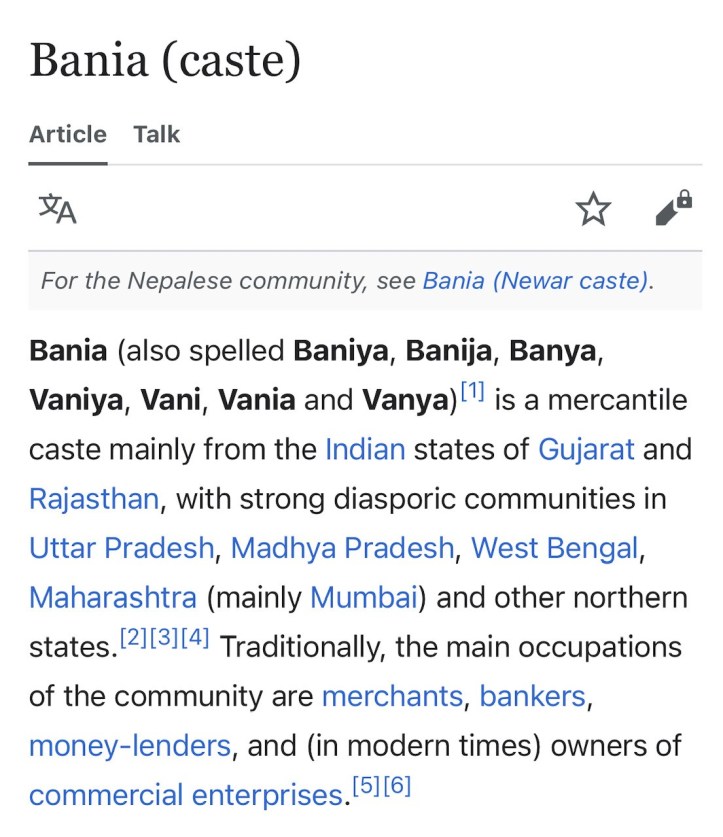
The screenshots below have been taken from the same official Wikipedia page. They describe how members of this caste would train their sons during childhood (homeschoolers, please take note):

Furthermore, not all of the habits of this Baniya caste were praiseworthy.
When I chanced upon this part (below), it immediately struck a cord with me, because I have personally known certain people hailing from business families in Karachi, who do what is mentioned below, even today.

And finally, this part (below) made me relate to the so many (innumerable) real-life accounts of descendants of the Baniya caste who were either thrown out of their homes and communities, or shunned and blacklisted, or both, – just for tarnishing their family’s honor, daring to challenge and defy the set-in-stone ethos, edicts, laws and policies that dated back to the era of their forefathers, or for marrying outside the community (Abdul Sattar Edhi being a prominent example of this).
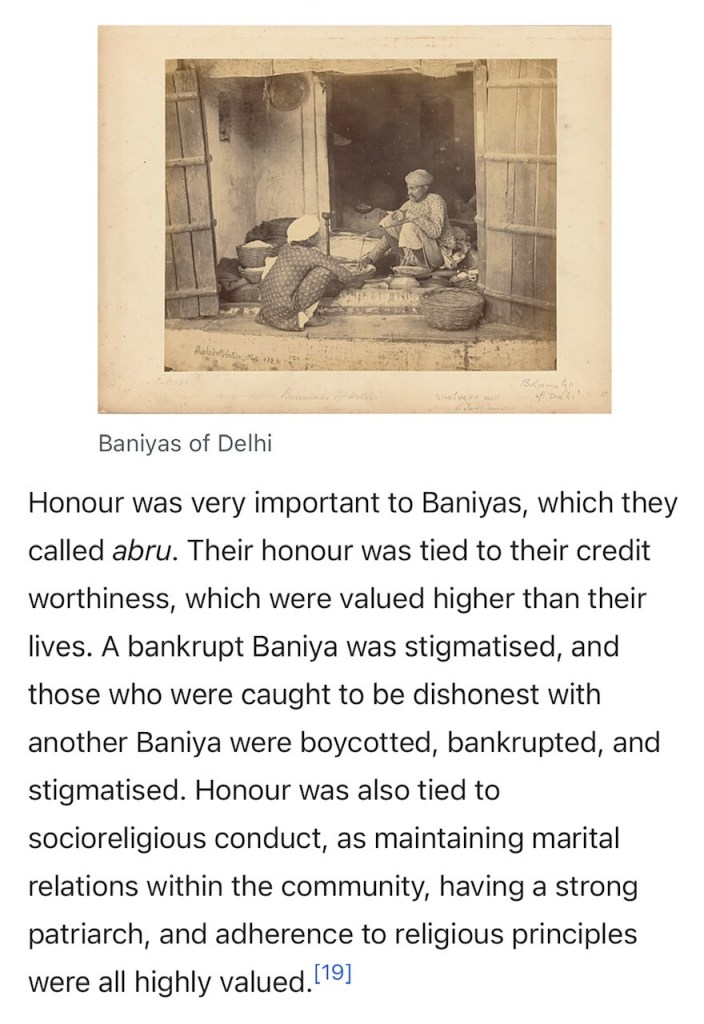
The above screenshots are merely information extracted from Wikipedia, which is not considered a reliable, verified, or fact-checked source.
So why did I share excerpts from it here?
I have chosen to share only that information which, according to my 40+ years of personal experience of living in Karachi, and interacting (socially and in a business setting) with many of the Karachi-based descendants of the Baniya caste, – is true.
Speaking of being raised in Karachi, the former capital and business hub of Pakistan …. a city that I once called my home, but from which I have fled, being repelled by its people on the basis of a concept that is corroborated by Islam, but which is popularly known as ‘the law of attraction’…. let’s now get to the point.
الأَرْوَاحُ جُنُودٌ مُجَنَّدَةٌ فَمَا تَعَارَفَ مِنْهَا ائْتَلَفَ وَمَا تَنَاكَرَ مِنْهَا اخْتَلَفَ
“Souls are recruited soldiers, and those of them that are familiar with one another will be drawn (to each other), and those among them that are dissimilar, will differ.”
The Memons and me – a long history
Growing up, whenever we would pass by the Aisha Bawany girls’ school that is located on main Shahrah-e-Faisal in Karachi, my mother would pipe up, “This used to be my old school!” She also told me how she had a friend who was from the same (Bawany) family. That friend went on to marry into the Ghani Memon family (or Gunny/Ganny, as they spelled it).
As fate would have it, I ended up sitting some A-Level exam papers in the building of the same school (designated as our examination center) in 1996. After marriage, I also happened to cross paths with the daughter of the same childhood friend of my mother’s, when I wrote for Hiba Magazine.
What I am trying to say is that, yes, it is a small world, and if you live in Karachi, your chances of crossing paths with Memons (hailing from any of the many Memon “jamaats”), and from members of the community who call themselves “Delhi wala’s”, are very high.
They form the business community that monopolizes this city, along with a few other clans and tribes.
During the nineties, we had a few neighbors in our Clifton apartment complex who belonged to the Kutiyana Memon branch. These Memons have many contacts and relatives settled in South Africa. Some of their distinguishing characteristics are that they prefer to live in apartments instead of bungalows, they have no dining table in their homes; they eat on a squeaky-clean tiled floor that is mopped – by hand, squatting – several times a day, and always own one motorcycle, to save on fuel for those minor errands that can be performed by a man (or boy) of the house, without needing to take the car out. This branch of Memons is found living around the Clifton area of Karachi, in apartments, spilling into the area around Delhi Colony and Civil Lines. Kharadar (with its aroma of fresh malpura’s) is one of their thriving hot spots. Sadly, another one of their distinguishing characteristics is that one (or more) of their children is often differently-abled, or suffering from a genetic disorder. This is due to their habit of intermarrying i.e. marrying off their children only to close tribal relatives (cousins marry cousins, one generation after another). And Allah knows best.
Most of my experiences with Memons before my marriage were with this branch of their community (Kutiyana). One of them confided to me that they have a thing against Bantva Memons. She did not elaborate further. She also told me that Memon jamaats are not very united on the inside; that when members of one jamaat sit together they nitpick other jamaats.
Another neighborhood family who lived in our Clifton apartment building (having the surname Hansrod), owned a grocery store at a walking distance, from which many of the building residents purchased their daily groceries. When I mentioned to one of their sisters that they are Memons (because everyone in the apartment building used to say that they were), she refused outright with a decisive shake of the head. “We are not Memons,” she said to me with finality, “…We are Gujarati.”
🤐
I have no idea what the difference is, because, according to my knowledge, Memons trace their origins to Gujarat and a few other places in India. It is like saying about a qorma, that it is not a curry, it is just qorma.
Anyhow, when I enrolled as a student at Al-Huda in December 1999, I was 21 years old, and had just graduated.
From then onward in my life, it was ‘Memons galore’ everywhere. This was because the members of one, very prominent Bantva Memon family were primarily responsible for bringing the founder of Al-Huda, Dr Farhat Naseem Hashmi, over from Islamabad, to conduct the signature Taleem Al Qur’an diploma course in their city (Karachi).
This Bantva Memon family have close links to 2 major Memon business empires: (i) the Jaffer Group, including the direct biological siblings, descendants, and close relatives of Abdul Kader Jaffer (who, sadly, also happens to be the biological paternal grandfather – or ‘Dada’ – of the infamous Zahir Jaffer, the convict on death row for the 2021 murder of Noor Mukaddam in Islamabad), and (ii) the Al-Noor Group of companies.
It should come as no surprise, then, that many of the students (both, full-time ones and casual listeners) of this first batch of Al-Huda in Karachi, back in the year 2000, hailed from the Memon community.
I happened to make some new friends and acquaintances who were from the “old money” business communities of the city (viz. Memons and Delhi wala’s) and was introduced, for the first time in my life, to their alternative lifestyles. For someone like myself, who was from the salaried (private-university-educated “doctor, engineer” 🙄) social class, it was a bit eye-opening to mix socially with members of these business communities.
They lived in and around the ‘cooperative housing societies’ of Karachi, such as P.E.C.H.S, Bahadur Yar Jung Housing Society, and Mohammad Ali Society (to name a few), in multi-storyed mansions that resembled palaces, the staff in which outnumbered the members of the residing family itself. Each family member had their own chauffeured car and personal servant, and there was a massive tijori in one central room of the palace in which they kept their cash (note: no personal bank accounts).
Everyone had a separate residential wing or portion of their own in the mansion, with personal servants constantly shuttling between these residential wings and the central rasoi, with trays laden with on-demand tea, snacks and meals. Intercoms were used excessively to contact other family members, or the servants, in the different wings and floors of the sprawling abode.
My time as a student at Al-Huda was idyllic. Fresh out of 3 dreary years at a private university, in which I had pursued a degree that I couldn’t care less for (I had no interest in any aspect of software engineering), studying the Qur’an was like a whiff of heavenly, soothing fresh air!
There were girls and women having surnames of Hanif, Zakaria, Soorty, Dadabhoy, Seja, Begawala (including teenaged Menahal), Kapadia, Dewan, Moon, Osawala, Chhotani, Mahenti, Haji, Makda, Pollani, and Chhapra attending the classes. I still remember studying for tests with Mushtaq Chhapra’s wife, who had requested my personalized help, with her adorable little daughter Rijah hanging around. Though she has forgotten me by now .. not that I mind. It has been over 2 decades, after all. Plus, I was a nobody. Even Hina Durrani, one of the daughters of the late singer, Noor Jehan, was a student in the subsequent batch. The first (future) Pakistani Oscar-winner, Sharmeen Obaid, who got married into the Memons (Fahd Chinoy of Pakistan Cables) also once attended as a listener (she wrote about it). So, yes, everyone from the who’s who of the Karachi business community was flocking to Al-Huda during those years.
From January 2000 till July 2003, Dr Farhat Naseem Hashmi taught the Taleem Al Qur’an course twice, to the first two batches in the city. Note: all 3 of her daughters – who were teenagers, – started and completed this course during this time i.e. in Karachi.
Back then, as a girl in my early twenties who came from an average family, I was invisible.. just an indistinguishable face in the crowd – something that I now regard as a coveted and long-lost ‘luxury’. Because I was a nobody in the midst of scores of older, prominent, cash-wielding, diamond-jewelry-flaunting, rich women hailing from the established and well-connected business families of Karachi, no one at Al-Huda even noticed me sitting among them.
And because I was invisible and a ‘nobody’, everyone showed me their true colors… everyone, – especially the staff members, – most of whom had been temporarily imported and flown over from the province of Punjab to help launch and establish the flagship courses of Al-Huda in Karachi. They all stayed, along with the founding family, in a ‘hostel’ – a house off Sunset Boulevard, in DHA phase 2, which was owned by the same Memon family of Al-Noor Group.
I haven’t forgotten a thing. The style of teaching and instruction at Al-Huda was super strict, minutely structured, and regimented, based on many unflinching rules. One such rule was not being even one minute late for any class without a valid reason (which you had to tell the staff); not leaning back during Qur’an Tafsir class unless you had a diagnosed medical reason, and not sleeping a wink after Fajr prayer.
This combination became a little impossible for most students (especially those who came from far-off areas) to uphold, and, once the clock struck noon, many of them would dose off during Tafsir class, only to be severely told off in front of everyone (more than 500 people!).
Going to the bathroom at Al-Huda was a luxury (I had heard from the course coordinator, sister S. Nawaz herself, that the girls staying at the hostel were not allowed to be inside a locked bathroom for more than 3 minutes!) and all the students got just 15 minutes of break time during the day (with socializing), in the time period between 8:00 a.m – 1:30 p.m, and that too, after many requests and demands. At the start of the course, the only ‘break’ allowed to students was to stand up from their seats, to “stretch” for 5 minutes, without talking to anybody, then sit back down.
Nevertheless, at this point I can say that many of the rules at Al-Huda were beneficial. But I wanted to share them here in order to express just how much the world has changed.
That being said, the first basic mistake made by the Al-Huda teachers and staff (most of whom were born and raised in the villages and small towns of Punjab), was to unequivocally apply their small-town tactics and archaic learning methodologies to the large student body of girls and women who came from a sprawling metropolis city like Karachi.
First of all, the sheer class size (500+) was historical for Al-Huda, plus the main hall would burst at the seams whenever the Tafsir class commenced and the casual listeners started pouring in. This required a daily hassle of asking the regular students to move up and ahead to accommodate everyone (which they didn’t like doing, and resisted/complained about), in addition to air conditioning issues during the summer months.
Secondly, the style of scolding, talking down to, disciplining, and reprimanding the students and class attendees, which was adopted by all of the teachers and staff – in order to make sure that the former obeyed all the rules – was highly inappropriate. The elderly ladies were especially miffed at being told off by staff members who were as young as their granddaughters.
The reason for this was (is) that small town people and big city people are totally different. You cannot deal with snobbish, haughty, uptight, urban-dwellers who are born and raised in a big city (like Karachi) the way you deal with simple and humble ‘small-towners’.
That was a major mistake made by the founding family and staff of Al-Huda. They had hitherto been teaching students in a small, picture-perfect, squeaky clean city like Islamabad (and perhaps, its other outskirts), and they applied the same teaching tactics in a filthy, chaotic melting-pot, multi-ethnic megacity like Karachi – without budging an inch from their etched-in-stone rules.
That was why, very soon, within just the first 6 months, protest and rebellion sprang up among a faction of the students, especially the older, highly educated, and well-off women, some of whom had left high-flying jobs to become full-time Qur’an students.
It was not long before things at Al-Huda began to seriously go awry. Our Qur’an teacher, Dr Farhat Naseem Hashmi, began to receive passive-aggressive and hateful comments on chits of paper, and via handwritten letters, from some students and attendees. 6 months had not passed since her commencing the course in Karachi that this hate began to turn into threats of a personal nature.
She continued, despite being shaken.
During the next 3 years, up till the year 2003, things had gotten quite worse. The immense positive response and support, not to mention praise, which Al-Huda and Dr Farhat Hashmi were receiving from the mothers, wives and daughters of the highly prosperous local businessmen, were beginning to attract the ire of the local Islamic scholars.
They began to nitpick, criticize and find fault with her views and opinions (that she expressed in her lectures and published literature), and call her out needlessly on trivial jurisprudential matters. She would ignore all of this at first, and even laugh off some ludicrous accusations, to continue with her work.
But it slowly began to get worse.
The turning point came when someone at Al-Huda (it was not known who) covertly committed an alteration of a book penned by Mufti Taqi Usmani (by adding two handwritten paragraphs of text to the printed manuscript), and he discovered it when people informed him about it. He called it تحریف and demanded a public apology from Dr Farhat Hashmi herself, though she did not know who had committed this abominable deed. She had not even known that it had happened, until it was shown to her, although the alteration was admittedly committed on Al-Huda’s own printing press (which was used for publishing the pamphlets and books carrying its official imprint).
There was an invitation extended to her to come and meet Mufti Taqi Usmani in person, along with their teams, to sort out the matter. The meeting never came about, because Dr Farhat Hashmi did not go. She said her husband did not want her, nor allowed her, to go (of course he was expected to accompany her).
Her no-show caused Mufti Taqi Usmani to become quite angry.
And, the rest, as they say, is history.
The Karachi chapter of Al-Huda that got off to a dashing and surprisingly successful start in the largest metropolis of Pakistan – initiated and sustained mainly by some of the prosperous Memon and Delhi wala families – took a crushing nosedive.
Two of the most prominent scholars of the country were prevented from even meeting each other in person, much less collaborating on future Islamic projects in the field of education, – a meeting that could have resulted in much spiritual welfare, spreading of Islamic knowledge, and betterment of the common masses dwelling in the largest, most over-populated, crime-infested, and sprawling city of Pakistan, – had Allah willed it to come about.
But Shaitan prevented it. A lot was said about this sad, history-altering incident. To this day, the movers and shakers of Karachi complain about how Dr Farhat Hashmi did not respond to Mufti Taqi Usmani’s invitation for in-person talks, and how much this snub offended him.
People have approached me about it as well, knowing how much inside information about Al-Huda I have, to find out why she did not turn up. I tell them what she told us ‘group in-charges’ in a staff meeting, “My husband [Dr Idrees Zubair] did not allow me to go and talk to them…..I insisted that he would accompany me, but he said to me …. you will go to talk to men now?”
Women and girls at Al-Huda (I call them ‘AlHudians’, and no longer consider myself among them) are not willing or trained to converse in a business-like manner with non-mahrum men (based on necessity, without khulwah, of course), so they avoid it as much as possible (even though Islam allows it), preferring to talk to non-mahrums through a mahrum male relative.
I used to strictly adhere to this strategy too, until, one by one, the mahrums in my family (do not include my son) began to get severely emasculated. In case you haven’t noticed that already…. all the men in my family are now mere puppets in the hands of their mahrum women. QaddarAllah. 😏
Coming back to the point, I have a few requests from the Memon community of Karachi, especially those (Bantva) Memons who catalyzed the relocation of Dr Farhat Hashmi to their city and facilitated her in every way (by providing her with a course venue; residential lodging for herself, her family, and her Islamabad team of staff members and assistants; and transport facilities, among others) to start Al-Huda courses here.
First, you should have protected her and stood up for her vocally when she started receiving death threats, and severe opposition from the city’s ulema (Islamic scholars). Just because she laughed it off and chose to ignore the risks, doesn’t mean you should have been silent bystanders, since she was a naïve and gullible ‘foreigner’ in this city, and you – being natives of the metropolis, with your vast network of connections and resources – were better aware of the graveness of the danger to her and her cause, and how quickly matters could escalate (as they usually do in volatile Karachi).
Secondly, although it has been over 20 years now (Dr Farhat Hashmi went to Canada in the second half of 2004), kindly do something to revive the tepid and defunct but picturesquely impressive Al-Huda campus that is located on main Khayaban-e-Shahbaz/Sehar (pictured below).

We all know how that can happen: only if Dr Farhat Hashmi begins to come to this campus regularly (which she no longer does), and not just on a flying trip. And if the leadership of this campus is handed over to a sister who belongs to your community.
Bear with me right now and hear me out.
Fact: Karachi ‘belongs’ to the business community (primarily the Memons and Delhi wala’s – and all those Hindustani people or ‘muhajirs’, as they call themselves, who tag their identities and businesses with names of cities and towns located in India), like I have attempted to highlight above already.
In lieu of what I have stated above about leadership, it is obvious to even the most indifferent bystander that Al-Huda has been experiencing a serious “crisis of leadership” since it took a nosedive in 2003. Anyone can see, even cursorily, what a tepid response they have had in Canada.
In the year 2018, I was offered the position of teaching tafsir full-time (6 days a week) at this Khayaban-e-Shahbaz campus (pictured above), by Dr Farhat Hashmi herself. I turned it down, because of several reasons, the main one being how this position does not allow the teacher even slight autonomy when it comes to teaching the Qur’an. An Al-Huda Qur’an teacher is obligated by Dr Farhat Hashmi to reproduce every word of the tafsir that is taught by Dr Farhat Hashmi herself (by first listening to it, then regurgitating it word-for-word, almost verbatim).
I do not think that scholars and thinkers who ponder deeply upon the Qur’an are produced like this … by sticking to every letter that their teacher uttered, and not using the heart and brains that Allah gave to them, to understand the Qur’an and explain it to others. I mean, imagine if every word of tafsir that was taught by Dr Farhat Hashmi in her courses, had been the verbatim reproduced words once spoken by her late father, Abdul Rehman Hashmi?
Would she have achieved the level of understanding of the Qur’an that she has today, by teaching her students this way?
Plus, 6 days a week was too time-consuming, which was the second reason for my refusal – that I was (and still am) a full-time homeschooling mother (too bad if that still makes you sulk, – deal with it), and that this personal familial commitment of mine would clash with the level of “commitment” that is required by Al-Huda of all of its staff members, – primarily Qur’an teachers and ‘course in-charges’.
Their work ethic consists of demanding dogmas and ethos that I do not agree with. They exhort: sacrifice your home in the way of Allah! Give up your children and your families in the way of Allah! Plus, the better you perform at your duties at Al-Huda, the more duties (and heavier ones) they pile upon your shoulders. It is no surprise, then, that the staff members who have been able to sustain this pressure and survived long-term at Al-Huda (such as, for the past 2+ decades) are those sisters who are not very… intelligent, highly skilled, or professional (please forgive me for saying this 🙏– but it is the bitter truth). They just do exactly as they are told, with no sign of personal innovation, creativity, achievement, or growth in sight.
In addition, excerpts from the Qur’an and hadith that mention the word jihad (such as this one) are quoted out of context to motivate staff members to leave their houses to go out and teach Qur’an classes at Al-Huda. Going out for Qital (armed conflict/battle) at the call of the Prophet ﷺ during his lifetime was obligatory for the male Muslims around him at that time, and these verses dealt with that. Quoting these verses as inspiration to make female staff members leave their homes to teach classes, – as if something terrible will happen to them if they do not, – is …. not very appropriate, nor wise. Nor is it mandated by our Shari’ah (Islamic law).
Anyhow, to come back to the point. This campus of Al-Huda needs a revival, and I think I owe it to them to suggest how, now that I no longer call Karachi my home.
This campus needs a sister from the local business community (primarily the Memons) to take charge. Someone older, who was born, bred, and educated in Karachi (to my knowledge, the current course in-charge is from Kharian) and has a sprawling network of established familial, professional, and political connections. Dr Farhat should collaborate with her (instead of micromanaging her) to grant her some autonomy in teaching the Qur’an.
That is my opinion. You cannot have a thriving center of religious education in a city like Karachi unless you are willing to collaborate with its locals, to make peace and maintain an ‘understanding’.
And the locals of Karachi … as I know only too well … do not shy away from bullying, intimidating, harassing, threatening and boycotting you, unless you put something ‘on the table’ for them.
This brings me to my second point. The Al-Huda Karachi ‘course in-charge’ needs to also have a collaborative relationship with the local body of ulema. And that brings us back to the crux of the problem: the unresolved dispute between Mufti Taqi Usmani (and essentially, everyone else at Darul Uloom, Korangi) and Dr Farhat Hashmi.
Unfortunately, Mufti Taqi has been facing his own challenges since the past decade or so. No, I am not talking about the two foiled attacks on his life. I am talking about how, since his two-decade-old Islamic Banking mission finally accomplished fruition in Pakistan and the government has now given a deadline to all Pakistani banks to become fully Islamic – some local Memons are calling for a practical boycott of local banks.
The person who is still my husband (!) informed me about a couple of Friday sermons that he heard in (the mostly Memon-attended) Masjid-e-Aqsa in PECHS block 6, last year (when he was living in a nearby guest house after being evicted from his parents’ house by his younger sister). The imam called for all attendees to withdraw their money from banks, to close all their bank accounts, and to return to storing cash in tijori’s instead. In another sermon, the same imam also advised the attendees to show discretion when throwing away used containers of “branded food” in their trash. He told them to cover up and hide (from view) these boxes properly before throwing them away, so that their neighbors cannot see them, because, he said, it leads to envy in the hearts of the latter. This clearly indicates that some Memons even stalk their neighbors’ trash …. in order to keep an eye on their spending habits. And Allah knows best.
So, like I said, whether it is a family or a religious education center – for it to thrive and grow in Karachi, it must have a strong local connection with its Memon community.
I hope that the Bantva Memons will ponder upon this, since DHA phase 6 (in which the AlHuda Khayaban-e-Shahbaz/Sehar campus is located) is an area in which most Memons are the Bantva “wala’s”.
As someone who had to flee from a crumbling Karachi just like her teacher Dr Farhat did 20 years ago, I feel that at least I owe it to the business families who are still thriving in this urban melting-pot of chaos to give them my two paisa’s (pronounced “pay-eee-saa”) worth of advice.
For whatever it is worth.
And Allah knows best.
My family connection with the Memons of Karachi
Al-Hudians would probably remember that, back in 2010, my only sibling had to endure what is referred to as “being left at the altar”. Oh believe me, the “Al-Huda grapevine” was immediately abuzz about it and this scandal was gossiped about for weeks, with their conversations showered with generous helpings of “astaghfirullah’s”, “alhamdulillah’s”, “jazakillah’s” and “insha’Allah’s” (as is their signature style).
At that time, I had been married for 5.5 years, and was following the quintessential Pakistani-aunty-given cultural advice of ‘shut your mouth and pretend that everything is okay’ and ‘keep quiet and give [your marriage] 10 years, then everything will be fine’. Sister Huma Najam had given the latter advice to one of my former friends (also an “Al-Hudian”) who was finding it impossible to keep her marriage going in the beginning, when she had just one child (note: she is still married, and a mother of 5, but always whining and complaining, still).
Anyhow, so I acted upon this advice and kept mum about the fact that, yes, my parents had been very mean to their would-be daughter-in-law. But the Al-Huda gossip circuit was abuzz with what had happened for quite some time, since the girl who had left was also …. an “Al-Hudian”. Back then, I did what any good Pakistani daughter (and daughter-in-law) is ‘supposed’ to do: she keeps her mouth shut and stands with her parents in the name of “family loyalty” and “blood is thicker than water”.
As my parents went about putting the entire blame of the marriage being called off at the 11th hour on the girl who had left (claiming that she was of a very nervous, jittery temperament), I kept quiet and did not let anyone know that I could completely empathize with her.
You see, my parents had begun to show her their true colors (and intentions) a few weeks before the wedding, and – in case you still do not know this – they can be very harsh, mean, rude, controlling, and disrespectful, when they want to be (especially behind closed doors).
Nevertheless, because my husband and I had been tolerating their totalitarian domination and abuse for the previous 5 years, they had probably assumed that their would-be daughter-in-law would tolerate it, too.
But she was the fortunate daughter of a well-off businessman and a loving mother (her mother has now passed away…may Allah grant her Jannah, Aameen); she had parents who really cared about her and her future happiness (unlike mine) .
So, she left. Good for her!
After that was over, both of the broken couple were terribly hurt, but my parents were completely unapologetic and defiant. Nevertheless, it was as if they had – practically, – been force-fed some very sour medicine. I think they realized that not every girl will put up with their mistreatment and abuse the way their daughter (me) and her spineless husband, routinely did. So they became a bit less toxic and demanding from then onward.
They backed off, and let me and my brother take over how his wedding would come about. Finally, he was able to get engaged again, through his own network of contacts.
You’d think our extended family would show some wisdom and respect this time, following the “once bitten, twice shy” approach.
But no.
The drama started again in our (eccentric) extended family when word let out that the family that my brother was marrying into was ….. Memon.
Oh man…. the things I had to listen to. 🙄
But I would counter all the protests and biased opinions with, “I have also heard a lot about Memons, but I have interacted with a lot of them at Al-Huda, and never seen anything that bad about them.”
The nikah took place at Makkah Masjid in Kathiawar Society, near Dhoraji, in Karachi, in 2012. This nikah has produced four children, masha’Allah, and it facilitated my brother’s emigration to the USA. In the 12+ years that have lapsed since this marriage, I have had to deflect many an awkward question from people (including my own toxic mother-in-law, with whom I was not estranged yet, back then), despite my tight-lippedness and self-erected boundaries.
But Pakistani people are relentless and invasively curious when it comes to married couples. Why did your brother go to USA when he did not even have a job there? How is he supporting himself? He used to be in Siemens (they still remember this!) … which company does he work for now? His children must also be homeschooled?
In addition to deflecting questions from outsiders, I have had to also tolerate remarks about the change that came about in my only sibling (related to his health and career) since his marriage, from relatives and extended family members. “He has changed so much”. “He is no longer like he used to be”. “He is not doing as well in his career as he should be”. “America has given him nothing. Why is he still living there?” “He should come back to Pakistan”.
The underlying implications are very clear. In Pakistani families, if care is not taken to glare at people to make them back off well in time, the “wolves just begin to howl” more loudly. Like vultures that circle a dying animal, Pakistani relatives begin to approach a struggling married couple with their offensive questions the minute they detect that the husband is jobless or floundering in his career, or falling sick and not recovering.
As I have experienced only too well during the past 2 years, fingers are always pointed at his wife. As if she is 100% responsible for any shortfall or mishap in his career or health.
We are Muslims, and we should be grateful to Allah that in our religion, unlike in the religion of the Hindus whom our ancestors used to live in close proximity to, back in India, there is no concept of shugoon (omen) related to a wife.
When a Hindu bride enters her husband’s home for the first time after the wedding ceremony, she is made to kick a vessel full of rice with her foot at the threshold, with the rice falling inside the home to (in their belief) symbolize and indicate incoming wealth, prosperity and livelihood in that home (through her addition to the family).
Only idol-worshipping Hindus, or the followers of other pagan dogmas and beliefs, associate a married man’s decline in health and wealth (after his marriage) with his wife’s “shugoon”.
As Muslims, we should never believe or endorse such jaahil thoughts, ideas, or beliefs.
I certainly do NOT.
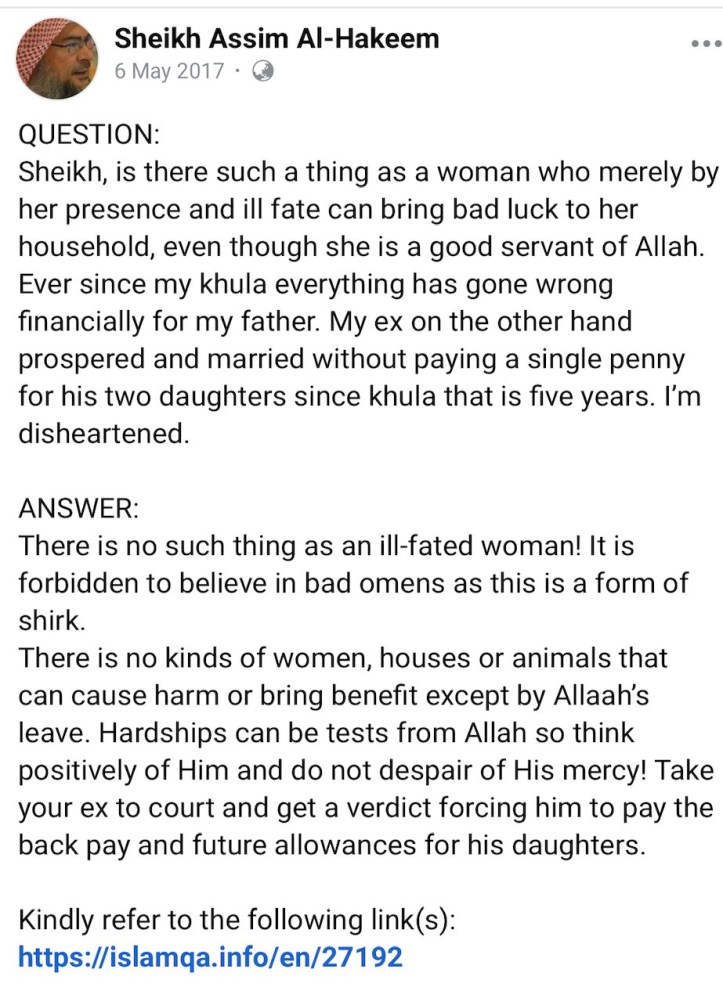
I hope that this will make it abundantly clear to anyone reading this blog post, that I am not like my evil in-laws, and never will be (insha’Allah) when it comes to in-law relationships.
I had never intended to be the vindictive and vicious older “Nund” (the evil kind depicted in the self-titled Pakistani drama series, which I never watched, but read about, in articles online); or the envious, homewrecking kind of nund that my own nund (Vajeeha Inam née Hasan) always was, and still is: ready to pounce on any mistake or shortcoming – big or small – that she sees in her brother’s wife, and lets not a single chance go by to fill his (and her mother’s) ears with complains and nasty comments about her bhabi.
I have curtailed a couple of friendships in my former circle of “Al-Hudians” some years ago, just because they decided to get a little too inquisitive about my brother and his marriage. They would ask me intentional, “loaded” questions, which I deflected. “But she does serve you, doesn’t she?” “It is not my right upon her …. that she serves me.” “But she should come and sit with you when you visit, shouldn’t she?”
What the H….? Back OFF already! ✋🏻🛑⛔️
SubhanAllah, sometimes I cannot stand Pakistani marriage culture. It is so toxic and suffocating!
Anyhow, in November 2022, my brother’s father-in-law (click or tap on ☜ this link to see his name) passed away peacefully. He was sitting in his home reading the Qur’an after returning home from Fajr prayer (his daily habit). He would sometimes fall asleep whilst reading the Qur’an. This time, he didn’t wake up from this sleep. Such a noble death, masha’Allah! To die with the Qur’an open in your hands. May Allah grant him forgiveness and admit him into Jannah. Aameen (please say “aameen”).
Now that it is known that my connection with the charitable and entrepreneurial Memon community of Karachi is not just that of religion/Deen (via Al-Huda, viz. coming together over 2 decades ago to study the Qur’an in the top floor of Metro shopping mall, Teen Talwar, Clifton) but also via that of family (in-law, through marriage), I would like to request all the Memons of Karachi to give heed to my advice below, which, I assure you, is given in sincerity:
– Please concentrate your efforts on maintaining peace and security in your city, instead of always taking out your binoculars to look at who has lately acquired wealth, and how much, and how this wealth of theirs can be directed into the Memons’ wallets.
– Please consider looking ahead, instead of backwards (in time). Yes, your forefathers were the pioneers and masters of trade and business, but times are changing, and you need to adapt to this change, even in business. In order to do this, you need to be less controlling and more respectful of your youth. In my counseling experience, young Memon boys and girls are desperate to marry outside their Memon community (the late educationist, Happy Home School’s founder, Ma’am Marium Faruqi, was able to do this), but most of them are prevented from doing this, by their elders. Please focus less on keeping your youngsters forcefully tied to the community by blood, and more on training them to be innovative and up-to-date with the digital revolution when it comes to doing trade and business. If not, most of your youngsters will just fly the nest on a one-way ticket as soon as they are able to, and become salaried professionals employed at companies in other countries, or businessmen married to foreigners (like Shahzada Dawood, who sadly died in The Titan accident)….or both. And you would have lost your next generation, who were supposed to be the torch-bearers of your religion, culture, language, traditions, and businesses.
– Please stop policing the earning/spending/budgeting/saving habits of other people (viz. ‘outsiders’ to your community), and stop being bitter about how your prosperous past business peak in Pakistan (circa. 1970’s) is now no longer there, and how Pakistan would not have been formed had one of your bygone Setth’s not given a crucial donation to Quaid-e-Azam Mohammad Ali Jinnah at a critical time (when the latter direly needed the capital for the formation of Pakistan), at around the time of partition. I lived for years next to 2 separate Memon families (surnames Hajiyani, Dojki, Bagasra), and though they were humble and quite likeable, they were constantly spying on our expenditures and day-to-day activities, but refrained from socializing with us (their children did not even make eye contact, let alone say salam). We ignored their constant (underhanded and veiled) comments about our spending habits, though in the same breath they would brag about how many properties they owned, and how the clay bricks used to construct their houses were of such a high quality, that they had been specially imported from another province in trucks. A point came when their spying and eavesdropping on us became completely and utterly unbearable.
This was when, whilst discussing the neighborhood’s deteriorating security situation, the Bagasra father-son duo chastised us for spending the amount of Rs XYZ per month (they quoted the exact number) on delivered food. As if it wasn’t creepy enough that they were stalking our food deliveries so minutely, the father then went on to brag, “I am sure this is not your calculation. This is the calculation of us father and son.” He was implying that we just randomly spend our money, without first budgeting or allocating how much should be spent on what per month. This was categorically not true. Everything was pre-planned and organized. But this is the sad fact that I am trying emphasize here: Memons unflinchingly believe that others (i.e. ‘outsiders’ of their community) just can not do money (viz. earning, budgeting, spending, investing, and saving) the way they can. And that is not true.
– Please advise your men to stop exploiting the needy and unfortunate poor people (primarily, the humble and hardworking Patthan’s) who approach them for employment. I have personally beheld or been directly informed of incidents in which affluent members of the Memon (or Delhi wala) business community delivered a tight slap (without a moment’s hesitation) on the face of one of their maids or peons, over a trivial issue. Furthermore, when an unfortunate but attractive young woman from another tribe or race approaches a Memon “Setth” for a job in one of his companies, he tends to offer himself in marriage to her. Noble action, isn’t it? Which brings me to the next point..
– When your men take a second (or third) wife (an occurrence that is not uncommon among Memon men, – one that is halal, of course), please advise them to practice strict justice between all of their wives. Deliberately keeping one wife hidden away in an apartment, without even showing or acknowledging her existence to your community, or allowing her to mingle with your family, is not appropriate. At my father’s former company, PPL, one of his Memon colleagues (surname Jandoola) would bring only his second wife to every official company dinner and event (he had 3 young children with her), and she lived in a tiny, 2-bed Clifton apartment. We did not even know that she was his second wife, until we came across members of his community at Al-Huda, who informed us that his first wife is from his own tribe, who (obviously) lived with his parents, and he has much older, grown-up children with her. I cannot even provide the details here of the many cases I have counseled, in which single young Memon men had led on attractive girls from other tribes, whom they met at their coeducational university. The story is the same: attractive, unobtainable (out of reach), pretty young girl. The “forbidden fruit”. She fell for it. But then, he turned his back on her and abandoned her the minute she started to talk about marriage, at which point his “mother dearest” entered the picture (“Norman Bates” style 🤭), and drove the final nail in the coffin. Soon, the girl would hear of his hasty engagement to his cousin, or to the daughter of one of his father’s business partners, and, nursing a broken heart, she carried this unwanted baggage into her own future marriage. I always advise such girls: be grateful to ALLAH that you did not marry him, unless you were willing to accept and adjust to being treated as ‘an outsider’ and a ‘second fiddle’ by him and his community for the rest of your married life, just because you were from another tribe. Fact: some tribes of Pakistan look down upon (and consider lowly) other tribes, and do not want their blood to mix with them. Hence, the rigid adherence to the unjustified and strict prohibition of inter-marriages between tribes.
– Not everything in life should be about making more money and garnering personal benefits. There are lots of business-and-trade-doing, “old money” families around the world, who know more about managing wealth, financial assets, savings, investments, and real estate, than the Memons of the Indian subcontinent do. Please accept this fact: that you are not better than everyone else when it comes to knowing the in’s and out’s of money. Perhaps you can read up about the business strategies of these “old money” families, and learn those halal ways of managing money and growing wealth from them that your forefathers were unaware of. Not everyone in Pakistan prefers to convert every extra wad (“guddee”) of cash into gold coins (guineas) the way you do. Not everyone watches the fluctuating exchange rate of the US dollar like a hawk every day, the way you do. Not everyone believes in having a tijori (safe) in their house instead of a bank account to store their “caysh” (and evade government taxes), the way you do. And that is fine. The world is big enough for all of us. None of us is better or worse than the other. We all make our personal decisions and choices. If you cannot see someone spending money in a way that you consider ‘squandering’ or ‘wasting’, then please…. instead of trying to come up with ways to divert and inject that (supposedly) ‘wasted’ money into the wallets of a Memon (or into a Memon-owned business)…. please just look away? And let them be.
– Please do not bend the rules of Islam, particularly related to halal and haram, when it comes to the growth of your business. As an example, please see the screenshot below, taken from an interview of the owner of Mehran Bottlers (the Pakola wala’s). The daughter of a Memon friend of my mother’s (whom she befriended through Al-Huda, as a student) is married into this “Pakola wala” family.

A Muslim-owned business collaborating with a brand like Heineken (Dutch company), which has hitherto made all of its money selling beer (alcohol)? And not only is it sad that this business deal, – between a foreign beer manufacturer and a Muslim-owned soft drink company – went through, but that it is being touted as a great achievement?
So what if this malt drink is non-alcoholic? The Dutch company with which the deal went through, sells alcohol, and has been doing so for years (since 1875). And a Muslim (Memon) collaborates with this well-known beer brand to manufacture a local non-alcoholic malt drink for Muslims?!
I wonder what the Al-Hudians would say to this? Because they used to regard drinking any soft (fizzy) drinks (including Pakola) as being disliked (makrooh) in Islam, because, in their opinion, soft drinks are impure (ghair tayyib).
Oh, but wait! No matter how much Al-Hudians condemn the spending of money on “over-priced” food and drinks, regarding it as israaf or extravagance, they never, ever refuse the chunky donations and funding coming from the families who own those companies, which manufacture these “over-priced” and “extravagant” food and drinks.
Which brings me to my next point…. read on below.
A glass of Coca Cola, a bar of Lindt chocolate, over-priced Mövenpick ice cream and Tim Hortons coffee
When Allah sent His Prophets to any nation, the Qur’an mentions how they were instructed to first convey His Divine message to the nation’s elite.
This is because, whenever the elite adopt a particular trend, habit, lifestyle, or ethos, the masses slowly but surely follow suit.
Along the same lines, if any positive change is to be initiated in society, it is the elite who are the make-or-break in the equation.
This elite class comprises not just of wealthy people, but of power players, respected and revered authority figures, thinkers, philosophers, and those occupying strong political posts. Those who have a say in society, and whose words and thoughts are given importance and weight in critical decisions that affect the masses living in that society.
Like I said above, when I was a student at Al-Huda, I was invisible. That meant that I could be anywhere, and no one would notice me. This meant that I could see and hear people doing or saying things that they would otherwise not do or say when they were being watched or heard by those whom they feared, revered, respected, or … took donations from.
During the course of my studies, there was much discussion around food in Al-Huda classes, because our teachers and staff members would tut-tut our eating habits, especially those that affected the class atmosphere. Students were not allowed to eat anything except during the 15-minute break, and this allowance prohibited all foods that could be spilled, or that left behind a strong smell. Eventually, on-site canteen services were outsourced to two needy sisters, who would bring in edible merchandise and sell it to hungry students during the 15-minute break. Nevertheless, the stern ‘food policing’ continued…
“You can eat a date or toffee (candy) discreetly during Tafsir class, to stop yourself from being overcome by heavy sleep, but the wrapper must not make a single sound!”, the course coordinator, sister S. Nawaz, would say to us on the mic.
As time went on, white sugar and refined flour began to be condemned, along with all soft drinks, chocolates, and packaged milk. Frozen yogurt, packaged cereal, mineral water sold in plastic bottles, white eggs, non-free-range (poultry farm) chicken, and cakes eventually began to be added to this blacklist.
Phew. A bit too much, maybe?
To this day, I do not understand the Al-Hudians’ fixation with condemning food & drink of different kinds.
Perhaps that is why, when I look back and recall a couple of incidents at Al-Huda that left me wondering just what was going on, the picture becomes clearer to me (now).
But it is not a very pretty picture.
The year 2000:
During the first Taleemul Qur’an course in Karachi, some students received an invite to a launch event in Park Towers Mall, Clifton, from another young student, sister S. Khaleeq (who is the daughter of sister F. Khaleeq, –both of whom hail from a Delhi wala family). She said it was an invite to try free samples of a product, which was part of a new business that her family was starting.
My mother and I went in the evening because Park Towers was at walking distance from our Clifton apartment at that time. Sister S. Khaleeq and other students of Al-Huda were there, in front of an ice cream shop. She asked us to sit down on some chairs, then she proceeded to hand us a scoop of the ice cream that was to be sold at that shop.
Can you guess which ice cream brand it was?
Mövenpick ice cream! We were thrilled to do the tasting for her (I was always a foodie).
But, wait a minute! Nowadays, one scoop of this “Swiss premium” ice cream (Mövenpick) costs around 2 USD (Rs 600).
How dare I endorse such over-priced ice cream?
Is it not “extravagance” in Islam to buy and eat such ice cream? Even once in a blue moon, just to try it?
The year 2007:
I am attending an exclusive Al-Huda dinner hosted for staff members at the sprawling P.E.C.H.S residential mansion of sister F. Khaleeq (the same lady whose husband had launched the Mövenpick ice cream brand in Park Towers Mall, Clifton, in the year 2000). Dr Idrees and Dr Farhat Hashmi, visiting from Canada, are also attending.
This event was not open-for-all. It was exclusive for Al-Huda staff members only. Dr Idrees gave all of us a presentation on the details of the newly acquired campus of Al-Huda on McAdams Road, Mississuaga, Toronto, Canada. In it, he expressed his immense gratitude to “Brother Khaleeq”, for having sent the major chunk of the financing that enabled the purchase of this campus building.
In short: the Al-Huda campus in Toronto was funded (for the most part) by the Karachi-based businessman from the Delhi wala community who (once) used to have a stake in the brand known as Swiss Premium Mövenpick ice cream (when the latter was launched in Pakistan in 2000… later on, it was bought by Nestlé).
Are you getting my point, here?
The Memon family that owns Al-Noor Sugar Mills, among other businesses (SUGAR…remember?), were the key players in launching the highly successful (but ill-fated) first batch of Al-Huda’s Taleemul Qur’an course in Karachi in the same year (2000).
Traders who import over-priced “Swiss premium” ice cream in Pakistan fund (almost entirely) the first and foundation-laying Al-Huda campus in Toronto, Canada.
Businesses that produce SUGAR in vast amounts in their mills, then sell it for a profit, help launch a religious education course in Karachi that brings – by the will and grace of Allah – the light of guidance to hundreds of local families and households…
Ice cream…
Sugar…..
Selling these for a profit to the masses…..
Dig?
Do you see what I am getting at?
But wait, it gets even better!
The year 2023:
Almost two years ago, in February 2023, the Internet “broke” with news of the launch in Lahore, Pakistan, of one of the most famous Canadian brands of coffee and doughnuts: Tim Hortons.
There were record-breaking sales and long, long queues in Lahore, with people waiting for hours to buy the coffee.
I got to know about this ruckus through a public social media post made by one of the teachers at Al-Huda, Canada. The Facebook post was, as I totally expected, full of passive-aggressive disdain and thinly-veiled “tut-tutting” about how sad it is that people in Lahore, Pakistan are queuing for hours just for coffee. However, smack in accordance with the signature Al-Huda “tut-tut policy”, she stopped short of naming the brand.
As I rolled my eyes, I decided to search the Internet and take a look at which coffee brand the Al-Huda staff members were indirectly taking a dig at, this time. Lo and behold! It was Tim Hortons, – a brand which, I have never shied away from publicly admitting, used to be one of the only few things that I liked about Canada (when I went to live there after getting married, in the year 2004).
The same Al-Huda teacher had once given me a sweet gift with a bit of a twist: a Lindt Excellence Chilli Dark chocolate bar. I never knew that chocolates infused with chilies even existed! But the point I am trying to make is that it is nobody’s guess that, back then as well as today, the Lindt brand is considered one of the most luxurious chocolatiers in the world; a “premium”, high-end brand of Swiss chocolate, which is out-of-reach for most commoners in Pakistan (including the old “nobody”, me).
And, yet, an Al-Huda staff member had it in her possession.
Yes, yes, I know, she must have received it as a gift, too, right?
And it was so generous of her to pass it on to me. Correct?
But hey…. is it not wrong (according to Al-Huda philosophy) to eat such over-priced, high-end, sugar-infused food items, according to their understanding of Islam?
To willingly ingest a combination of sugar and chocolate, after paying a significant amount of money from your own pocket just to eat a few bites of this “unhealthy” food?
So why pass it on to me? Especially when it has chilies infused in it? 😖
Makes you wonder, doesn’t it? Which brings me to my next point..
The year 2001:
I have successfully completed my Taleemul Qur’an course back in the month of May, and am volunteering at Al-Huda as a staff member in their “multimedia department”, a division that produced and presented supplementary audio-visual content (mainly PowerPoint presentations) for Al-Huda classes. It was my Bachelors degree in Software Engineering that made the senior staff members (mainly sister N. Nadeem, a cousin of Dr Farhat Hashmi’s oldest son-in-law) decide to place me in this department.
I was also under part-time training as a writer (!) and translator, under the guidance of the staff member who was the official “writer” of Al-Huda back then. She wrote Urdu and English content for the literature (mostly pamphlets) published by Al-Huda. She also helped prepare Dr Farhat Hashmi’s daily Tafsir placards (don’t ask, outdated activities of the pre-digital-revolution-era), among other duties.
For this ‘training’, I had to go to the Al-Huda ‘hostel’ located off Sunset Boulevard in DHA phase 2 during the day. One day, my mother got late in picking me up. It was winter, and as fate would have it, I was making up one of my qadaa Ramadan fasts that day. As afternoon turned to evening, one by one, all of the staff members who had come to the hostel for work, left to go home. Only the ‘hostelites’ were left (viz. staff members who were temporarily imported from the other cities of Pakistan, staying at the hostel full-time).
The hostel was eerily quiet. I did not have even a bottle of water or date handy. When 5 minutes were left for maghrib, I decided to go upstairs near “Madam’s” office (she was not called “Ustadha” at that time) and find someone to enquire if I could have a glass of water.
When I went upstairs, sister “A” (an imported staff member who was living at the hostel) immediately came forward from an inner room with a weird expression on her face: her eyes were glaring at me but her lips were forming a forced smile. She asked me what I wanted.
Now look, I do not blame her. The upper floor was exclusively for “Madam” and her family (including the upstairs kitchen). I was clearly ‘trespassing’, and minor things had disappeared (got stolen) often from Al-Huda premises from time to time, so she was, as the Al-Hudian tags say it so clearly themselves, “On Duty”.
But there was no one downstairs for me to ask for a glass of water… so I did not know what to do?
Anyhow, I told her about my awkward, unexpected situation in an apologetic manner, and asked her for a glass of water, and maybe a date, to open my Ramadan makeup (qadaa) fast. The maghrib adhaan had clearly begin to sound by then.
To my surprise, her expression underwent no change. In fact, she became even more curt and recalcitrant.
She asked me to wait (right there in the landing/hallway), and disappeared into the upstairs kitchen.
Wow. I was wondering, does she not believe that I worked at Al-Huda? That I was a student there, up till a few months ago? Did she think that I was a stranger who’d just randomly walked into the hostel from the street outside? I sure felt treated like a beggar.
After what was more than 5 minutes (the adhaan had ended), she appeared with a tall glass filled to the brim with ……. I could not believe what I was seeing with my wide, aghast eyes.
Coca Cola.
Yes. Coke!
I looked at her in silent disbelief, not blinking. She handed me the glass (it was filled to the brim) silently, her eyes still glaring.
I took it. She then walked off very fast into an inner room, shutting the door behind her. As if to tell me to now make myself scarce.
I went back downstairs into the empty foyer, sat down, and broke my fast by taking a few gulps of the beverage that all Al-Huda staff members, without exception, considered and openly called “ghair tayyib”, and condemned us students for drinking.
She had filled up the glass with Coke right up to the brim, in order to rid the Al-Huda kitchen of as much of this condemned, unwanted beverage, as possible.
Clearly, the staff members at Al-Huda received many “high-end” and other ‘gifts’ from their wealthy fans, admirers, and well-wishers that they did not like or consume.
So they took the chance to “pass on” these unwanted “gifts” to nameless, faceless, “nobodies” like me, who came to volunteer their services to Al-Huda during the day, six days a week; to sit around waiting for their official writer to become free of her primary duties to train me in becoming a writer (!) for Al-Huda …. nobodies like me who were stupid enough to not bring along a date or a bottle of water to break my qadaa Ramadan fast myself (I had not expected to get so delayed in being picked up).
Like I said, when I was a nobody at Al-Huda (and everywhere else), I got a chance to see everyone’s true faces. Especially behind closed doors, when there was no one else around.
Some time later, I got news that this sister “A” had gotten married….
…. to Dr Farhat Hashmi’s younger brother.
And Allah knows best.
The year 2004:

As a newlywed, I am sitting in my apartment in Toronto, wanting to contact my teacher, Dr Farhat Hashmi. I am all excited about going to meet her, because I have just been told through the “Al-Huda grapevine” that she has arrived in Canada.
However, I do not know at what time I should go to the Al-Huda campus in Mississuaga, to find her present there. Because I am already pregnant (although not sick…yet), and living in North York, the ride to Mississuaga would not be short. So I want to ensure that I will get to meet her if I do go all the way to Mississuaga. But, as has always been the case, getting in touch with Dr Farhat Hashmi directly is a feat that is almost impossible to achieve – her emails are always checked and filtered by (one of) her team of personal assistants, and I do not have her phone number.
That being said, I am no longer a “nameless, faceless nobody” to her, because from 2002–2003, I was the “Group In-charge” (oh.. how I have always disliked that title!) of the English group in the second batch of the Taleemul Qur’an course that she had conducted in Karachi, so she knows me very well by now.
Then an idea strikes me. An Al-Huda staff member had told me the name of the lady in whose house Dr Farhat would be staying. I take a chance and look up the name (“M. Qureshi”) in the phone directory that my husband has. I find the landline number almost immediately.
Then, I make the call.
Sister M. Qureshi (an older, Pakistani “aunty”) answers the phone herself. When I ask her to let me speak to Dr Farhat Hashmi, her tone changes immediately and she gets straight to the point.
“Listen, if you want to meet “Madam”, then either you come to the Al-Huda campus in Missisuaga to meet her there, or you-” then she gave me another option about going someplace that I cannot remember. She proceeded, “But she can not come to this phone to talk to you, and you cannot meet her in this house.”
She was very curt and rude. She also did not bother to ask me who I was, and why I wanted to talk to Dr Farhat.
I thanked her in a very small voice.
She then hung up the phone.
As fate would have it, I became extremely sick due to pregnancy in the coming weeks, and could scarcely conjure up enough energy to get out of bed.
It was then that, ironically enough, the tables turned.
Dr Farhat’s daughter emailed me to ask me to come and meet her mother, who was about to go back to Pakistan.
Being contacted by a member of the Hashmi/Zubair clan….
Wow…. what an honor and privilege.
I responded via email that I was pregnant and very sick, but she insisted that I come, because there was something important that her mother wanted to meet me about. She did not mention what it was.
I could not go. Unlike Mufti Taqi Usmani’s personal invite to Dr Farhat Hashmi for an in-person meeting, which she did not accept without giving him any reason for it (because her husband would not allow her to go), this invite of Dr Farhat Hashmi to me was not turned down for this reason. My husband (whatever he was – and is – like) was willing to take me to meet her …. but I was so sick, I could scarcely walk!
Really, this is the truth.
My no-show clearly did not go down too well. Dr Farhat Hashmi left. The same daughter (can you guess which one of her 3 daughters this is?) emailed me to inform me that she had gone. This time, her tone was rather cold …. and disappointed. She told me to await further instructions about what her “Mama” would want me to do next. She did not even bother to sympathize with my medical condition.
But that is a pure ‘Al-Hudian’ for you. They think that even if you die of dehydration on their campus whilst teaching one of their classes, it is an honor and a privilege for you. And that Allah will not question them about why they didn’t give you a glass of water to drink!
It is what you can do for Al-Huda that matters to them. Not what Al-Huda can do for you.
They are perfect.
I have never made my phone conversation with sister “M.Qureshi” public before, but I am choosing to do this now, because during the past 2 decades, a lot has been presumptuously said about me in the staff circles of Al-Huda, about why I do not work for them anymore, nor socialize or keep in touch with any of them.
I have always chosen to remain quiet; the same mistake that I made about my in-laws, husband, and parents.
But now I want to speak out to set the record straight.
First of all, let me finally put something out there: that my marriage was arranged by the fledgling “Al-Huda marriage bureau” in December 2003. My mother had secretly (without my knowledge or consent) submitted my profile into this “marriage bureau”. Sister N. Naeem (who is now deceased, may Allah grant her forgiveness, aameen) handled this “marriage bureau” back then (along with a few others), and she had personally sent the proposal that eventually led to my marriage, to my parents’ house (she had shortlisted it after saying that she saw “a match” 🤨).
Now that that is out there, let us admit the fact that if I was in Canada with my husband as a newlywed, it was indirectly because of the Al-Hudians, who had (through its “marriage bureau”, and through piling the pressure on me to get married) contributed towards bringing about this relocation of mine to Canada.
Secondly, about me obeying the curt “stay away!” instructions of sister “M. Qureshi”. As is their historic habit, the “Al-Hudians” will put the entire blame on me.
“Why did you not just keep calling her up until she let you talk to her? Why didn’t you say it was important? That you were a group in-charge in the Karachi course?”
“Why did you give up so quickly? You should not be so touchy!”
This psychological tactic is called “gaslighting” someone. If someone is rude to you and you rightfully feel offended, instead of blaming and calling out the rude person for their offputting behavior, the onus is put on you – for being “too sensitive”; for not “forgiving”; for not “keeping your heart clean”.
Secondly, I do have some self-repect. I have a spine. I am not a shameless “chumchee” (sycophant) of Dr Farhat who follows her around everywhere, waiting for her “nazr-e-karam” (gaze) to fall on my ardulent face.
Sorry if I am not like you.
Had Dr Farhat Hashmi trained the people (“sisters”) whom she chooses to surround herself with all the time, in being more polite and wise when it comes to dealing with incoming personal visitors and phone calls, and bothering to correctly identify the right people who were trying to get in touch with their “Madam”, by filtering the sincere ones from the time-wasters and haters, – things might have been different today.
Dr Farhat Hashmi went back to Pakistan and told a class full of women in Karachi (one of whom promptly ran to my mother to inform her!) how she had wanted to hand over the management of the entire setup of Al-Huda in Mississuaga to “Sadaf Farooqi” – but,…. she said, “the meeting could not happen”.
Since sister “M.Qureshi” had not even bothered to ask me my name when I had called, how could Dr Farhat have known that the person whom she’d wanted to hand over the entire class of Al-Huda Mississuaga to, had wanted to come to meet her in person, just a few weeks prior? I had intended to meet her to discuss how I could contribute to Al-Huda Mississuaga on a part-time basis, since I was in the family way (expecting my first child).
Oh… the irony.
Today, 20 years later, whose loss do you think it was that that meeting between Dr Farhat and me in Toronto did not come about?
Mine, or Al-Huda’s?
Only Allah knows best.
All I know is, I have no regrets about coming back from Canada., despite the life that awaited me in the mayhem-fest that is Karachi.
It was Allah’s decision for me, and my heart is totally at rest about this.
As for the staff members in Canada (past and present)… sisters G. Qureshi (and her mother-in-law, Moona), T. Zubair, M. Wasti (among other new ones)… they all used to be my students, helpers, or colleagues, back in the day. All I know is, that the Canada setup of Al-Huda today, after a duration of 20 years, can be called “lukewarm” at best, compared to the charged, “red-hot”, full-speed-ahead one that Karachi generated in just 4 years, 2 decades ago.
You reap what you sow.
Spiritual “LaunchGood” for my mother
People put up appeals for financial help on LaunchGood, Patreon, or a GoFundMe all the time. In these, they describe the unfortunate and sad situation of a particular person, group, city, or country, and receive donations for them, to help their cause.
I have no intention of garnering any financial donations. But I do want to request that those readers of this blog post, who have somehow miraculously been able to read it up till here (without skipping anything in the middle – you are a rare, dwindling breed of human readers, do you know this?), please pray for my parents’ guidance – especially my mother’s.
She is seriously unwell mentally, in a very morbid way. However, if you talk to her (somehow), she will make you believe that I am the one who has all the problems. Do not be surprised if she says that I have lost my mind; that I have gone missing, or that I have been abducted or kidnapped by someone.
None of what she says about me is true.
What everyone who talks to her – everyone – needs to realize is that the solution and cure to her mental breakdown is not to enable her direct “communication” with me – which is what she desperately wants.
Rather, the solution is to get her the medical help that she needs. This, she always refuses, so you have to find a way to do it against her will.
You can start by not mentioning me or my children to her. Never bring up my name or my children’s in her presence.
Secondly, I have met and spoken to a few of her cousins, and told them about her deteriorating condition. They are willing to help her.
But again, she refuses to even meet or talk to them. One cousin, the daughter of her paternal uncle, lives within a mile of her house (at walking distance). She is the wife of a former Assistant Managing Director in PPL, Mr. Khalid Raza, a very decent and humble person who has always been on good terms with my father. This cousin is willing to come over and help my mother in any way, along with her older sister (a doctor), who lives with her husband (also a doctor) just a few miles away.
But no, my mother refuses to meet both of them, or to accept their help.
Then there is her much younger maternal cousin, childless and twice divorced, a khala’s daughter (named Shagufta Shahid), who lives alone in Karachi, and is financially supported by her 3 married brothers (whose wives refuse to let her live with them). She has contacted my mother again and again, requesting her to let her live in one of the spare bedrooms in her house (as a paying tenant). Once, she even begged her to let her move in, whilst sobbing. But my mother always refuses her, on petty grounds. This has been going on for some years.
So, you see, it is not true that my mother is all helpless and alone. She just adamantly refuses everyone’s help because of her depression.
Physically, she is not doing so bad, – she has one bad knee, which can be fixed with KRS (knee replacement surgery), which my father is more than willing to get done – but mentally, hers is a very sad situation.
As far as I am concerned, no amount of talking to her, in person or on the phone, will extinguish her anxiety and fears about me and my children, unless the four of us agree to live like prisoners, day in and day out, in the room right next to hers (without going anywhere outside her house) – where she can see us, in person, throughout the day and night, to alleviate her fears and doubts about our well-being.
That – I am afraid – is impossible.
Texting or emailing her is out of the question now, because she fears that someone else (such as a hacker or kidnapper) is sending her those texts and emails from my phone.
Sigh.
I tell you… it is bad.
Please remember her in your dua’s.
My father, though he will never admit it, is living like “a hostage” with her. She rules everything in the house with her (red-hot) iron fist, and if he disobeys her commands or goes against her wishes in any way, she “punishes” him by refusing to eat anything herself, not cooking anything for him, nor letting him eat any food ordered from outside the house. This can be potentially fatal for him, since he has diabetes, so you can see how dangerous the situation is. He has no choice but to agree with everything that she tells him to do…
Even if it is to accuse his own daughter (and her children) of placing a verse of the Qur’an on top of the trash….
If she commands him to do this… he will do it.
Once again, I have informed my paternal uncle (and his wife and daughter) about this situation. He lives less than a mile away. When my mother found out that my children and I were now talking to my father’s brother (my Chacha) and his family, she forbade him and his wife from visiting the house. Anyway, I have requested this uncle to keep meeting my father covertly at the masjid to keep an eye on his health and diet, and to give him food to eat if my mother has had one of her spells, in which she refuses to eat anything herself, nor lets him eat anything either (besides biscuits, nimco, corn flakes, or fruit).
A year ago, I was a mess. My parents had imprisoned me and my children in their house, and told me not to talk to or meet anyone, except my brother, who agreed to everything they said.
My children and I decided to fight back, and I told the world everything.
Someone out there prayed for us, and here we are today, free….
I can only say to those blog readers of mine who prayed for us – may Allah grant you everything righteous that you ever ask for, and more! Aameen. 🤲🏼
People say, “Take it all off your blog! It is gheebah! It is airing your dirty laundry in public!” to which I say, “Some of the people who are the most sincere to me in this world right now, are those whom I have never seen, nor met in person. They are old readers of my blog, and they pray for me, and want good for me, unlike you, who chooses to be the enabler of chronic abuse.”
Besides, as fate would have it, hardly more than a handful of people (many of whom are haters and enemies) can read my blog posts in full.
So …. your point is lost.
Conclusion
To quote what I said at the start: leadership is not about wielding power over others and scaring them into submission and obedience. Leadership is about serving and benefitting others, protecting them from harm, and guiding them towards a better future by paving the best way forward yourself.
Leadership is not about talking down to others, making them obey archaic and outdated rules that are not suitable for them (based on their background), and meting out punishments for non-compliance, whether it is through withholding privileges, or giving them an embarassing earful of a loud, demeaning diatribe in front of hundreds of others.
Most importantly, leadership is about leaving behind a lasting legacy that continues after the demise of the leader, through the natural vicegerency of capable, worthy, inspired and motivated torch-bearers and successors, who do not have to be coerced, cornered, manipulated or cajoled into carrying on the work of the leader after the latter is dead and gone from this world.
It is true that every “Alpha” has his or her (or their) own domain of activity in which they lead others, and when one Alpha enters the realm or territory of another Alpha, conflict and chaos ensues,– unless one Alpha backs down and willingly becomes a “Beta” within that domain only, just to maintain the peace and facilitate the continuance of the greater good for the masses who dwell in that domain.
This is what happened in the year 2000, when D Farhat Hashmi entered Karachi with her Al-Huda courses. The city was the “religious authority” domain of the Islamic scholars who founded Jami’a Binoria and Darul Uloom Korangi. It would have been beneficial for her to collaborate with them so that Al-Huda could continue to grow and thrive in the largest city of Pakistan.
But alas, that did not happen.
And look at the state of both, Al-Huda Karachi, and Al-Huda Canada, today. Anyone can see the reality pretty clearly.
You would disagree with me only if you had not seen the whirlwind of productive growth that Al-Huda experienced in Karachi from the year 2000 till the year 2003. There was some reason that Dr Farhat Hashmi chose to enroll all three of her daughters into the Taleem Al Qur’an courses that she taught herself – during this time period. Most of the founding team members working in Al-Huda USA and Canada right now, have been imported (or is it exported?) from here.
Nevertheless, the local scholars stepped in, and the rest, as they say, is history. To this day, I wonder who it was that committed that scandalous, handwritten alteration (تحريف) in Mufti Taqi Usmani’s book, using Al-Huda’s printing press?
Does that sorry person even realize the scale of the fitnah (tribulation) that their abhorrent action caused?
Let this be a reminder for anyone – anyone at all – who deliberately (because of a lack of wisdom) creates distance, dissension, or discord between two people who are serving Allah’s Deen – your action will impact and deter the betterment of hundreds if not thousands of common people! Just like sister “M.Qureshi’s” knee-jerk reaction to my phone call did.
Nevertheless, what is not meant to be, will never be.
Allah chose for Prophet Ibrahim and his nephew, Prophet Lut (علَيهِمَا السَّلَام) to have different domains and countries for carrying out their respective missions of Prophethood. Prophet Ibrahim was a Rasool-Nabi, whereas Prophet Lut was a Nabi only.
Perhaps that is what Allah had preordained for Karachi’s Mufti Taqi Usmani and Sargodha’s/Islamabad’s Dr Farhat Hashmi. And Allah knows best.
I leave the reader now by reiterating my request for the Memons of Karachi: kindly try to patch things up between Mufti Taqi Usmani and the female scholar that you imported to your city back in the year 2000, – Dr Farhat Hashmi.
If you succed in doing this, it will be a tremendous good deed (sadaqah-e-jariyah) for you, and will (insha’Allah) result in long-term good in a city that is, literally, “going to the dogs” viz. crawling with druggees, beggars, homeless people, (stray and pet) dogs, overflowing sewage and trash, street crime and chaos. Alcohol and drug addiction is disgustingly rampant. No matter how much the Karachiites adopt the “ostrich’s” approach of putting their head in the sand, and deny that their city is crumbling, fact is fact. Time will tell.
Now that you know that I have a family connection (in law) with Karachi’s Memon community, perhaps now you will sit up and take notice?
As a “Sigma”, I sign off and bid you and your city (that used to be my hometown) goodbye. 🫡
Discover more from Sadaf’s Space: From Blog to Books
Subscribe to get the latest posts sent to your email.

 Sadaf’s Space: From Blog to Books
asalamualaikum,
If you would like to write 1 or two essays on few selected topics at a reasonable price, please contact me at shakeeb.ar@gmail.com
Salam Sadaf,
loved this post and glad to hear from you again after soooo long. I was worried about you because you hadnt posted in a while and prayed you and the fam were okay.
Alhamdullilah, you were able to leave Karachi and are hopefully in a better place now with your kids iA!
Agree with the Memon mentality about money, I had a boss who would scrutinize, pocket watch and be very intrusive about my money habits and family life. It was very strange, I didnt realize it was a Memon thing but it truly needs to stop.
Sad to hear about Al Huda, the only positive things Al Huda has created is it allowed you to gain knowledge so many people can learn from you. I have benefited immensely from your Quranic tafseer posts-especially the ones based on Surah Yusuf.
Second positive thing about Al Huda is Ustadha Tammiyah, she works for Al Maghrib and is a very knowledgeable person and excellent speaker/lecturer.
I know what you are struggling with, with your mom, its definitely not easy, but glad you are not in that space. Praying for your mom, iA! she gets the help she needs.
I had a tiny request, can you remove ads? There were some seriously inappropriate ones I had to quickly scroll through.
Other than that, I learned not to put people and organizations on pedestals, people can be quite scary and jarring in real life.
Please keep us posted and keep writing, always look forward to your posts and I really miss the Restaraunt review posts lol.
Alaikum ussalam sister Nasreen. Jazaki Allahu khairan for your support and dua’s.
WordPress.com has changed over the years, so the ads are out of my control. I wish this “obscene ads” curse was not there on the Internet, at least in specialized content-niches such as those that publish only Islamic material.
As for “Memons” a.k.a Gujarati’s … the descendants of the Hindu tribes of “Lohana” who reverted to Islam in Sindh (in modern-day Pakistan) some centuries ago….sigh. My personal experience with them has been….. suffocating and traumatizing, to say the least.
As long as you do not have money, power, or influence of any kind (including fame), you’re safe in their company. In fact, you will even find them to be super nice, generous people.
But the minute that Allah tests (or blesses) you with money, power, and/or influence (including fame or popularity…i.e. any element that can attract a crowd or following),….. just watch out!
You will instantly ‘pop up’ on the “radar” of this internationally-displaced, totally disunited community of Memons/Gujarati’s — and they will tenaciously follow you around, fawning, “fangirling”, and over-adulating you …… at first.
But if you refuse their ‘baits’/invites to join (i.e. be thoroughly exploited by) their entrepreneurial efforts and organizations, they will stubbornly not let you go.
They will then stalk, police, harass, hound, corner, beg, and even threaten/intimidate you, to try to usurp the money/power/influence you possess in totality ….. to ‘milk’ it in full, for benefiting their own community and businesses (or both).
Be warned! I take Allah as my witness when I say all this.
A bloodhound or shark that smells blood cannot hold a candle to a Memon or Gujarati “baniya” who can ‘smell’ money and influence.
Assalamoalium,
I find myself visiting your blog as my comfort spot when I need to feel the presence of another muslim sister who I can resonate with. we have more in common than most people in my life. Starting with similar backgrounds , middle class family, grew up in Karachi , avid readers since childhood , attended the “good” schools, educated but also aware and critical thinkers, realised that Quran meant to be understood rather than just recited , attended Quran course at Alhuda to aid this journey of understanding the Quran, got married , had kids and decided to homeschool them. Felt increasingly suffocated in Karachi due to several reasons and with Allah’s will and help moved to another palace in Pakistan and ending on the unfortunate reality of having belonged to a dysfunctional family which appears perfectly functional and normal on the outside.
In a world where parents are the epitome of unconditional love and sacrifise , facing challenges as a family escape goat can be isolating. There is little support and acceptance of the wounds of an adult with complex trauma and next to no understanding of how respect for oneself and drawing boundaries with caregivers does not equate disobedience of Allah’s command to respect and honour ones parents. With the will and mercy of Allah I have come a long way in my journey towards accepting, understanding and moving forward in my journey but I still have moments where I wish to be in the presence of someone who would do as little as hold space for my grief. And if not that I can at least do the same for another muslim sister because I know what it feels like. So if this resonates with you feel free to reach out to me.
Alaikum ussalam sister Amna.
May Allah reward you for reaching out to me. Aameen. I cannot tell you how much comfort your supportive comment brought to me.
Unfortunately, since the past few years, I could not comment (or reply to comments) even here on my blog, without people being sent to harass me to respond to the intimidating emails and other messages of my abusers. Allah knows to what great extent I have been intimidated, persecuted and harassed during the past few years.
I resolve to fight back against every falsehood, injustice and oppression that I can, till my last breath.
Allahul musta’an.
May Allah grant you ease in all your affairs, and envelope you in His Mercy. Aameen.