
بِسْمِ اللهِ الرَّحْمٰنِ الرَّحِيْمِ
Disclaimer: The post below contains book spoilers. Read at your own discretion.
There have been many instances in my life when I made the mistake of deciding to read a book because of its cover, or because of what it appeared to be.
When you are young, you can be excused for this mistake because of your lack of life experience or wisdom.
But how can you be excused for this folly when you are a full-blown adult? And that, too, one who is now on the back-end of the book publishing industry i.e. someone who builds their own books from scratch (including covers)?
I am no expert on book cover design. I also don’t care for being one, no matter who exhorts to me, and how much, that I should go for professional book cover designing services. This is because .. well, you should hopefully find out the reasons for that in this post.
Books, like any other product that has to be sold, need a particular form of packaging to attract the right customer. Advertising and marketing jargon and mantra right there.
As is probably obvious by now, I don’t particularly care for the commercial aspect of my supposed ‘success’ as a book author. I hope to go for long-term authenticity and credibility. I also don’t care much for the many, innumerable book covers that I have had the chance to view before I decided to flip through the inside contents of the books that they were on.
Sure, to a certain extent, the cover design of a book matters. That is true.
But the question is – how much of this design is based on the commercial (promotional) aspect of publishing the book, to make sure that it sells? And how much weight is the book’s cover design given, by the marketing division of a publishing company, in ensuring that all of the costs that the company has incurred in publishing and printing it, are not just covered, but that significant profits are also made?
Good question right there.
“Your book covers suck!”
No one has said that to me, to date.
Well, not in those exact words.
But yes, the owner of an Islamic bookstore did say this to me once, not-so-subtly in other, politer words. This person then launched into a (*yawn*) monologue about how important book covers and the dimensions (size) of a book are, if an author wants their books to sell. How a book looks when it is placed on a bookshelf, they emphasized to me, is crucial in making a potential buyer notice it, pick it up, and decide to purchase it. I was further advised to re-design all of my books so that they were all the same trim size (cookie-cutter-culture-based dogma right there) and hence could be displayed side-by-side, all of them together, on a single shelf in their store, and eventually, after showing me many traditionally-published Islamic books with exemplary book covers (i.e. in their eyes), I was advised to go to Kube Publishing in order to have all of my self-published books published ‘properly’.
This was way back, in 2018, one-and-a-half years before the covid-19 pandemic hit and forever changed the way business around the world was done, and in lieu, their store – with all of its well-stocked shelves beautifully displaying same-sized books – shut down for over a year.
I had been asked to meet this person in order to negotiate a potential business deal with them that would allow me to place my self-published books on the shelves in their store, for local sale.
It probably goes without saying, that they never heard back from me after this (futile) meeting.
It is not that what they said was wrong. It is just that I don’t care.
I have no interest in giving importance to the cover design of a book, or to focusing on adhering to modern-day marketing and advertising mantras in order to generate and grow sales (as I mentioned in my previous blog post).
I prefer to focus on establishing long-term authenticity and credibility as an author, like I already said, and hope that this should suffice, along with suitable book covers.
 That being said, even I was given no say, as a first-time ‘published author’, in finalizing the design of the cover of my first book, Traversing the Highs & Lows of Muslim Marriage (pictured on the right), which was published traditionally, by IIPH, an Islamic printing press.
And, despite the fact that its cover design was handled by professionals, I don’t particularly like its cover, to date.
It is too cliched.
Book Covers as ‘Click-Bait’
Anyhow, now that I have explained enough the fact that I don’t much care about book covers, I want to provide a list of those books that I have had the misfortune of deciding to pick up to read, based mostly on what these books looked like to me on the outside. That is, the way they were ‘marketed’.
I am detailing this list because I want to emphasize what a long-term, off-putting, absolute turn-off it is for a wannabe, eager reader like me, to pick up a book and decide to read it (and maybe even invest in it by making a purchase), because of the misleading image that the book gives off about the content inside it (including what its back cover text/description box says about it).
It is precisely because of these bad experiences of mine, which left a bad taste in my mouth, that I do not care much for what the modern-day publishing industry (and its scores of marketing-mantra-touting, millennial professionals) say about the importance of ‘book marketing’ and promotion.
Because of the way the books below were designed and marketed by the publishing companies that produced them (with the exception of one, which I have mentioned right at the end, which is a positive example) I ended up picking up these books to read, but I got so turned off, that I did not finish (#dnf) most of them.
The couple that I did manage to finish, were novels that I suffered through purely due to a forced, last-ditch effort and hope on my part that they’d get better as I read them till the end.
But they didn’t. 🙄
Secrets of Divine Love by A. Helwa
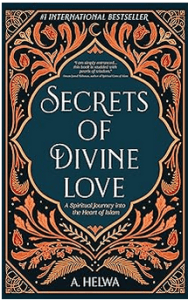 The Amazon AI algorithm is perhaps responsible for suggesting this book (pictured on the right), when someone browses my bookstore on Amazon.
This is actually what got me interested in it, at first. I wondered why Amazon was suggesting this book along with mine.
Unfortunately, I found it a few years ago, on sale at Liberty Books. I eagerly bought it, wondering what was so special about it, that it was receiving so many five-star ratings and positive reviews (literally in the thousands) from Amazon buyers.
If you want a very detailed account of why you should not read this book, you can read it here, on GoodReads.
This book is living proof that deviance and misguidance can be paraded around and even sold as the ‘guidance of Islam’.
This book is full of false information about Allah. The ‘sugar-coating’ is overpoweringly intense, but it doesn’t change the fact that was lies beneath it is pure falsehood and lies.
In case you ever come across this book, especially if it is being ‘recommended’, advertised, or displayed as ‘suggested reading’ to you on any webpage, especially along with any of my books, please remember that I completely and utterly condemn this book!
Avoid it at all costs, and warn others about staying away from it as well.
I am literally stuck with a copy of it, wondering how to get rid of it. Because I am afraid that anyone who gets their hands on this copy of mine after I have given it away, will get misled about Allah, and I am fearful that this will add very morbidly to my book of sins.
*Shudder*
Ayesha at Last by Uzma Jalaluddin
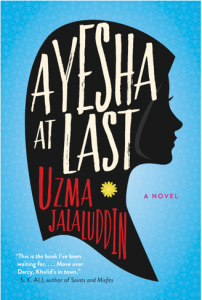
“Step aside Mr Darcy, Khalid is in town.”
Slice Jane Austen’s Pride & Prejudice with Indian/Pakistani Muslim immigrants in Canada, and you get a feeble attempt at Muslim minority representation in books, titled Ayesha at Last.
Since Jane Austen became world famous, the story of her novel Pride & Prejudice has been used to sell everything, from spin-off novels, to films (and their remakes), to television mini-series. It works like a charm every time. The fact is that anything based on Pride & Prejudice sells. All an actor has to do to become famous, it seems, is to be asked to portray Mr Darcy in a film, and … viola! Their career gets a boost.
I found this book at a local used-books store. I picked it up because I was very curious to see what the modern Western-Muslim-YA (Young Adult) fiction-publishing genre was churning out.
I am sitting here wondering if there is anything positive that I could say about this piece of writing. Well, I can come up with this: the author, sister Uzma Jalaluddin, is a very gifted writer.
To me, the novel seemed to suffer through the forced pigeon-holing of modern-day Pakistani-Canadian characters into the synopsis of Jane Austen’s Pride & Prejudice. And failing at it.
There is tremendous stereo-typing. As if the publisher wanted to force a certain type of cliched character from every category there is, into the story. Such as a white-supremacist Islamophobe (Sheila). A nice atheist (Clara and her boyfriend). A culturally-rigid, racist, and controlling immigrant parent (Khalid’s mother). An awkward, frigid, judgemental, introverted, and clumsy ‘practicing Muslim’ (in a thobe …. *yawn*) who fails to impress non-Muslims in most social situations, no matter how nice he is as a person (Khalid).
Just like it was the case in the next book that I will discuss (below), it came as no surprise to me that the main protagonist’s best friend, an atheist named Clara (who was perhaps supposed to represent the ‘perfect’ Jane Bennett, or maybe Charlotte … I am not sure) , turned out to be the best, most ‘perfect’ character in the whole novel – dignified, non-judgmental, patient, nice, kind, loving, respectful, unconditionally caring, and non-racist.
Everyone else, from Ayesha’s poetry-quoting, cigarette-puffing, ever-jovial Nana as Mr Bennett; Khalid’s harsh, gold-bangles-wearing, controlling mother as Lady Catherine De Bourgh; his sister Zarina as Georgiana; Ayesha’s superficial, runaway cousin Hafsa as Lydia (I’m guessing that Hafsa was either Lydia or Charlotte, but I could be wrong, since I was plodding through the novel against my will anyway), to the cheesy, over-the-top finale of the story set in the supposedly ‘resplendent’ backdrop of the quintessentially-Indian cultural wedding, traditionally stemming from Hyderabad-Dakkan (a state or province which is now known as Karnataka), complete with a model of the over-rated Taj Mahal in the middle of this ‘grand’ wedding (why, oh why, must all South Asian stories, films, dramas, soaps, and now, even Western-media-published novels, be incomplete without a ‘grand desi wedding’ happening in them? WHY?), I felt that this novel tried way too hard at forcing the author, sister Uzma Jalaluddin’s writing talent into the mold of Pride & Prejudice – just to be ‘woke’; just to tick the check-box of ‘diversity’ (Muslim minority representation); just to fulfill the new rules of the HR strategy of the publishing company (Penguin, Random House) that required them to mandatorily churn out a fixed number of ‘Muslim YA novels’ every year: that is, fiction books written by Muslims, for Muslims, with mostly all-Muslim characters, and a Muslim main protagonist.
In that case, they pretty much did what HR wanted them to do.
Kudos to that, I guess.
Infidel by Pornsak Pichetshote & Aaron Campbell
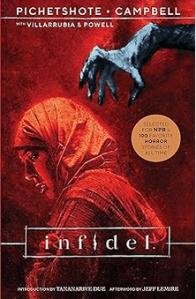
As I have mentioned in one of my recent blog posts, The Adventures of Tintin was a series of comicbooks (graphic novels) that had a very positive impact upon me during my childhood.
With teenagers and a tween in my homestead now, who have thoroughly enjoyed the Tintin collection, I wanted them to read a modern-day graphic novel that was clean yet gripping, and preferably had a ‘Muslim’ aspect in it as well.
This would, I had hoped, enable them to compare how graphic novels have evolved over the decades and generations.
So when someone visiting from abroad insisted that I tell them what they could bring for me, I decided to look for a graphic novel that was not too kiddie, nor completely ‘adult’ i.e. clean and entertaining. So I started searching for ‘Muslim graphic novels’ online, and Infidel (pictured) came up in the search.
A horror graphic novel with a hijab-wearing female character on the cover, which had a story involving jinns?
Of course I was interested!
I immediately decided to ask my contact to bring this horror graphic novel for me.
But, what can I say…… to this day I thank Allah for giving me the gut instinct to decide to check out its contents first. I managed to read it all online ….. and ….. sigh … can I just say that I was shocked to read it from cover to cover.
Of course I did not want any of my children’s eyes to fall anywhere near the contents of Infidel!
Apparently, if I am not mistaken, Infidel had been published somewhere in chapters, just like the Jules Verne novels, Tintin series, and The Adventures of Sherlock Holmes short stories were originally published in magazines and newspapers in periodic sections or columns, which enabled their authors to become very popular over time as they began to amass a dedicated, loyal readership that was incessantly hungry for more of their content.
Infidel is about a main character, a Pakistani-American girl (surprise, surprise, her name is also ‘Aisha’ – apparently this name has become a very popular one for female Muslim characters in modern YA novels) – who is engaged to a guy named Tom who has a little daughter named Kris, and an elderly mother named Leslie. They move in to live with the latter, in an apartment building in New York, which is haunted (inhabited by jinns that attack anyone who has racist or xenophobic thoughts, ideas, beliefs, or discussions). In the past, there was a bombing in this building, the mention of which keeps coming up throughout the story as it progresses, putting the pieces together, as does Aisha’s childhood best friend Medina, who was born and raised a Muslim but is now an atheist, yet she is still close to Aisha and very loyal to her.
This graphic novel is ….. extremely explicit and graphic (pun not intended). I do not think the images in this novel are at all suitable for young, impressionable minds. The jinns are beyond scary – they are horrendously grotesque, ugly and hideous (not to mention, some of them are buck-naked). There is more splattering of blood and gore in the end (when Medina uses Aisha’s misbaha beads to get up the courage to fight the jinns in the basement, as Aisha lies comatose in hospital, in a heroic bid to save her best friend’s life) than found in many horror films (the slasher kind).
But nowhere on the Amazon page for this novel is it mentioned that the content in this graphic novel is not suitable for most adults, let alone teenagers or younger children. The morbidly detailed, up-close images of the mangled jinns when they attack a victim are very disturbing, as is the heavy use of filthy language found throughout the novel (a generous dose of the ‘F-word’ seems to be in normal, everyday use of many of the characters).
This is shocking, because it is highly, off-puttingly unsuitable for many readers, be they young or old.
And this aspect should be mentioned as a warning or disclaimer on the novel’s description page!
Plus, not that it matters that much, but since I initiated this discussion from the topic of misleading book covers, I have to mention that the cover of Infidel is a tad misleading because the main Muslim protagonist, Aisha, does not even wear the hijab in her day-to-day routine. She wears it only when she is praying salah, so who is the hijab-wearing female person pictured on the cover? The face is not the main character, Aisha’s.
*Spoilers ahead*
Lots of the main characters are killed in the story, including Tom’s mother, Tom, and sadly, in the end, Medina, who heroically sacrifices herself to save Aisha’s life. Once again, as was the case in Ayesha At Last, the reader walks away from the novel deeming the respectful atheist-apostate to be the one with the most honor, generosity, respect, and courage; the true ‘hero’ of the story.
The only positive aspect of the entire story, in my opinion, was the flashback Medina has of a conversation she had with Aisha about having (or losing) faith, just as she is about to be killed by the jinns. In this conversation, Aisha tells her that when the time will come, the faith in her heart will arise and help her. Medina then grabs a bead from Aisha’s misbaha, which gives her the courage to shoot from a revolver to ignite the gas in the basement that causes an explosion, just as all the jinns are closing in on her.
Like I said, there is a lot of violence, blood, guns, gore, and ….. extremely ‘colorful’ language. Whenever a hideous jinn (or more) emerges from the dark depths of the haunted building to attack a racist person, it does so amid an echoing of slurs and heavy curse-words that would make even the toughest gangster’s eyes widen. So I was beyond grateful to Allah that He guided me to check out the contents of this graphic novel before I made the mistake of acquiring a physical copy for myself.
What a relief!
I therefore reiterate: do not ever make the mistake of deciding to buy a book, especially for your children, based on what its cover looks like, or what its 5-star rave reviews say about it online, especially on Amazon.
Use your common sense, sense of good judgment, and heed your intrinsic gut feeling. Don’t be easy fodder for flowery, feel-good, and ‘woke’ promotional mumbo-jumbo and advertising that makes you jump the gun and buy something that you’ll regret setting your eyes on later.
Ick!
The Tea Trolley by Rehana Alam

I got my hands on this ‘novel’ by chance. I found it lying around a house where the author, Ms. Rehana Alam, had paid a condolence visit, bringing it along as a gift for her hosts.
On further digging, I discovered that this book is a product of what is known as ‘vanity publishing’. This is when an author pays a printing press, not a publishing company, an amount of money (usually these fees are a substantially high amount) to have their book manuscript printed into a predetermined number of copies.
The author then does whatever they want with these copies: sell them, give them as gifts etc. This is how ‘vanity publishing’ works.
Anyhow, if anyone who does not hail from desi culture wants to get a good idea about just how misogynistic our culture is in South Asia, they should just pick up this book and give it a read.
The novel is about a girl who is reaching marriageable age, and her mother (*eye-roll*) decides that she “needs to be settled”. What follows are stories within the story, narrated to this girl by women from within her social circle (via word of mouth), about the (rather sordid) intimate details of the marriages of other women, usually from the previous generations.
Sounds okay to you, so far?
Now look at the cover of the book again. It is quite childish, in my opinion. If you take all the text out, it’ll resemble something that an 8-year-old child might have drawn in their sketchbook.
But that’s the whole point. I judged this book by its cover. I skimmed through the first chapter a little, then tossed it to one of my children to read when they were bored.
“Try to get a feel of what arranged marriages and the rather pathetic desi rishta process is like,” I said. “In the past, the girl being ‘checked out’ for marriage would be expected to wheel in the tea-trolley in front of the people who had come to her parents’ house to ‘inspect’ her as a possible bride for their son. Hence, the cheesy title.” I tried to explain.
A few days later, one of my offspring comes up to me and says that this book contains content that is rather inappropriate. I brushed off their concerns, wondering what’s the worst immodest thing that a conservative lady like Ms Rehana Alam (I know someone who has worked with her in a professional setting) would write in her book?
But my child insisted that I read chapter number so-and-so and see for myself.
When I read it, I couldn’t believe what my eyes had just seen. Revolting is the word! How could a book that looks so innocent on the outside, have such Sidney-Sheldon-type, lewd nonsense inside?
But then, my mistake, I guess. I judged a book by its cover again.
Be warned, this book contains details of such alarming but covert sexual innuendos disguised as ‘marriage stories’ of the women of the subcontinent (India-Pakistan region) that anyone who is foreign to the region would be surprised at the hypocrisy prevalent in the people hailing from it. I mean, at one point, we are infamous around the world for throwing acid on our daughters’ faces, or killing them in the name of honor if we so much as suspect them (without proof) of having an illicit liaison; and forcing them into marriage with strangers against their will; at the other, we write so-called ‘humorous’ stories about our men engaging in incestuous relationships under our own roofs?
I for one am not ashamed to say that, as a Pakistani woman, I condemn what happens to girls in our region in the form of forced marriages (and coercion, emotional blackmail, and entrapment, all qualify as forms of ‘force’)!
Stay away from this book! I am shocked that some readers found its contents ‘humorous’.
If this is humor for them, then they truly might be a sadistic lot.
Nusaiba and the 5th Grade Bullies
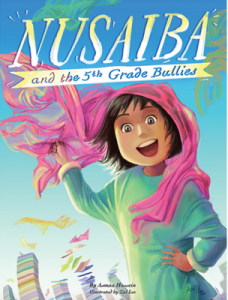
Finally, a good example of me judging a book by its cover, and not regretting it.
I bought this book in order to gift it to someone who has a daughter named Nusaiba, who was 5-6 years old at the time.
It did not disappoint. The illustrations are good, although I would discourage the drawing of eyes on animate beings.
The story is engaging from start to finish, keeping the reader glued and interested. The unexpected twist is also surprising, although I have [*spoiler alert*] never met or known of any Muslim woman entomologist in my life. But I know that this will not be the case in the future, insha’Allah.
Also, I have not yet come across any Muslim woman, young or old, who would wear a large, animal-shaped hijab pin, especially one that is big enough to be noticed from afar. Not that our Shari’ah would allow that, either.
Besides, most women are turned off by the mere sight of a tarantula, real or fake!
Besides these two points, I found this book to be one of the better experiences of my judging a book by its cover, to be a good enough investment to not just go ahead and purchase it, but to also gift it to the hijab-wearing mother of a little girl named Nusaiba (who live in the West), and not regret it.
Conclusion: The Purpose of Book Covers in the Digital Age
“Aspiring authors, get this through your head. Cover art serves one purpose, and one purpose only: to get potential customers interested long enough to pick up the book to read the back cover blurb. In the Internet age, that means the thumbnail image needs to be interesting enough to click on. That’s what covers are for.” ― sci-fi writer, Larry Correia
“In the old days, books had awful covers and marvelous content; nowadays, the opposite happens.” ― Italian poet Giacomo Leopardi (1798―1837), Thoughts
As an author, I would take a reader (or customer) any day, who might or might not be too happy with the cover of my book, but who has benefited from its content, even if a little.
Contrast that to having a book cover that drives scores of ‘conversions’, but the ‘converted’ readers eventually walk away, disappointed.
At the end of the day, what ultimately matters in the non-fiction book genre (and perhaps in fiction as well) is that a book that people read is of benefit to them; it helps them, guides them, makes ease for them, uplifts them, and brings about a positive change in their lives.
And in this motive, my perennial inspiration comes from the best book that can be read by anyone, in the world today: the Qur’an.
Discover more from Sadaf’s Space: From Blog to Books
Subscribe to get the latest posts sent to your email.

 Sadaf’s Space: From Blog to Books
I’ve self-published 2 of my own books, and for the first, I did the cover myself (albeit from a Canva template), after being unable to produce or afford to hire someone to create the visual concept I wanted. For the second, I was fortunate to find a very cheap local designer who was able to work with the concept I wanted, some samples, and produce something I was happy with. THe content is always more important. But the cover is the cherry on top.
But from a potential reader perspective, like you quoted, covers (and spines, if you’re looking on a library or store shelf) are always the entry point. The cover gets the attention – it’s the first impression, followed by the blurb as the second impression.
In the end, to me, the content as well as the writing style are always most important. It needs to gel with me, otherwise – no matter how noble or beneficial it may be – I just cannot force myself through the book.
Thank you so much for pointing out that book secrets of divine love it’s absolutely a sham and the shocking thing is Gen Z is absolutely loving this book which is quite shocking hope people will realise what a sugar coating that book is
You are welcome, brother. This book is extremely dangerous for those who have little to no knowledge of Islam, because it puts forth falsehood and misguidance wrapped up in the truth of our beautiful religion, Islam. Islam has got not even a sliver of falsehood in it. May Allah grant all of us guidance and the furqaan (criterion) to be able to differentiate between the truth and falsehood. Aameen.