بِسْمِ اللهِ الرَّحْمٰنِ الرَّحِيْمِ
The word “hijab” is often misconstrued to mean just a Muslim woman’s headscarf. For many, it is just a piece of cloth that is supposed to cover a Muslim woman’s hair.
In reality, the Arabic word hijab means “barrier”. Therefore, when it comes to observing “hijab” in front of non-mahrum men, it involves not just the physical appearance of an adult Muslim girl or woman, but rather, her entire demeanor.
Allah says in the Qur’an:
وَقُل لِّلْمُؤْمِنَـٰتِ يَغْضُضْنَ مِنْ أَبْصَـٰرِهِنَّ وَيَحْفَظْنَ فُرُوجَهُنَّ وَلَا يُبْدِينَ زِينَتَهُنَّ إِلَّا مَا ظَهَرَ مِنْهَا وَلْيَضْرِبْنَ بِخُمُرِهِنَّ عَلَىٰ جُيُوبِهِنَّ
“And tell the believing women to lower their gaze and guard their chastity, and not to reveal their adornments except that which normally appears. And let them draw their veils over their chests…” [24:31]
In the above verse (number 31) of Surah Al-Nur in the Qur’an, Allah exhorts all Muslim women to do what he has commanded Muslim men to do in the preceding verse of the same Surah (number 30) i.e. to lower their gazes and to guard their chastity.
In verse 31, however, Allah goes on to issue Muslim women two extra commands:
-
That they not reveal their “zeenah”except what “normally appears” of it, and
-
That they let their head-coverings (“khumur”, which is plural of theArabic word “khimaar”) cascade over their chests.
This implies that Muslim women should take care not to reveal whatever comes under the heading and definition of the Arabic word “zeenah”, whenever they are in front of any adult men who are not their mahrums (or even those women who identify as ‘L’ or ‘B’), or when they are present at any place in which they can be seen by the latter (either live, or later on) e.g. where there are CCTV cameras present, or any other recording/broadcasting medium that can capture their images.
What is “Zeenah”?
In the Arabic language, the word “zeenah” means (that something or someone is): adorned, ornamented, decorated, bedecked, garnished, embellished, beautified, or graced (Lane’s Lexicon).
In the Qur’an, Allah uses the word “zeenah” in other contexts, which we can ponder upon to better understand the implications of this word. For example, in verse 7 of Surah Al-Kahf, Allah mentions how He has endowed what is upon the earth with “zeenah” in order to test mankind, which one of them is best in deeds.
In verse 16 of Surah Al-Hijr, Allah mentions how He has endowed the heavens with “zeenah” for those who look up at them.
Bring to mind how beautiful the sky can look, at any time of the day, because of its varied palette of colors; in addition to the sun, the moon, the clouds, and the glittering stars at night, just as the beauty of the scenic views of diverse natural landscapes around the earth takes our breath away. With this analogy, we can derive a pretty good perception of the word “zeenah” from the way that Allah has used it in the Qur’an. Colors, glitter, sparkle, hues, shades, lighting, textures, and the different kinds of creation, such as trees, meadows, lakes, mountains, snow, rivers, and oceans – all come perfectly together to form spell-binding views that take our breath away.
Keeping this analogy in mind, if anyone uses their common sense, they will realize that the word “zeenah” – when it is used in relation to women, – encompasses anything and everything that is provided, either as a product or service, by the worldwide “beauty, fashion and lifestyle” industry. This thriving industry runs on the historic desire of women to beautify themselves, and therefore, never goes out of business.
It is no secret that, for centuries, the beauty and fashion industry has served women more than men, in any region or culture of the world. Historically, beautification or “zeenah” has always been more of a prerogative for women than for men.
And hence, the Qur’anic injunction for Muslim women to not reveal their “zeenah”, except that of it which ‘naturally appears’.
What is “Zeenah” when it comes to women?
Colors, patterns, textures, prints, cuts, and glittery embellishments – the way that women’s clothing can be styled has no end. Then there is jewelry and gemstones, and makeup.
 Finally, as if all this was still not enough, there are shoes and other accessories (such as aviator sunglasses and handbags), which are designed to enhance a woman’s overall physical look i.e. add to her “zeenah”.
Be it her eyelashes or her tiniest toenail, there will be something for it out there, which the fashion industry offers to a woman, to beautify or accentuate it for her.
Allah has commanded Muslim girls and women not to reveal that which falls under the heading of “zeenah”:
According to majority of Muslim scholars, the word “zeenah” in the above verse 31 of Surah Al Nur literally means ‘adornment’, and includes both:
(a) That which Allah has adorned (i.e., the woman’s natural and/or physical beauty), and,
(b) That with which they adorn themselves (i.e., jewellery, eye shadow, attractive clothing, hand dye, etc). The word ‘khumur’ (plural of ‘khimaar’) refers to a cloth that covers the head (including the ears), hair, neck and bosom.[Hijab: definition and conditions – Islamweb]
It can therefore be gleaned very clearly that it is not just a headscarf that covers the hair on the heads of Muslim girls and women that Islam has mandated.
Rather, everything that comes under the broad heading of “zeenah”, such as makeup, accessories, jewelry, and embellished clothing – should be covered up – with the exception of “مَا ظَهَرَ مِنْهَا” i.e. “what ordinarily appears thereof”.
So, what comes under مَا ظَهَرَ مِنْهَا?
- A Muslim girl’s or woman’s height, size and stature. No matter how well she covers herself up, these cannot be hidden.
- The material, texture, style, and color of her headscarf or khimaar, and that of her outer garment or jilbab.
- Some scholars opine that the face and hands come under مَا ظَهَرَ مِنْهَا, so a ring or or two on her fingers, and a wristwatch or bracelet that is visible on her cuff, also falls under مَا ظَهَرَ مِنْهَا.
- Eye glasses (spectacles) that she customarily needs to wear, to improve her vision.
- Non-flamboyant, natural makeup (also known as “zero” or “nude” makeup) that is used to cover up scars or skin blemishes.
- Socks, shoes, and handbag.
Besides these allowances, the overall hijab of a Muslim woman mandates that she strictly avoids wearing strong perfume when she is outside her house, and never conduct herself in a manner, – using her voice, words, gait, mannerisms, or body language, – which is provocative or attractive in nature.
Also, the above allowances that fall under مَا ظَهَرَ مِنْهَا should not be deliberately exploited for ostentation e.g. by purposely wearing heavy kohl or fake lashes on the eyes, brightly colored enamel or fake nails with eye-catching ‘nail art’, chunky and flashy rings and tinkling bangles, sparkly stilettos, or a brightly colored or heavily embellished khimaar or jilbaab.
The fabric of the outer clothing that a Muslim woman wears to cover up her “zeenah”, should not fall under the category of “zeenah” itself!
“But … I want to look beautiful! And to be told that I do.”
It is every girl’s desire to look pretty. She wants to receive compliments for how she looks, and to be told how pretty she is, if not outright beautiful. This desire among female human beings is natural. It is also a test from Allah.
That is why, when the time comes in a girl’s life to get decked up as a bride, not an inch of her persona is left un-embellished. Heavy jewelry, special makeup, an elaborate hairdo, henna on very limb, intricately embroidered clothing, flower-wreaths, …. you name it. Elaborate photo shoots with special backdrops are meticulously planned and set up to capture the moments in which a bride is fully resplendent in her splendor.
Sadly, it is during these moments of self-indulgent pride and joy that many Muslim girls and women disregard and disobey the clear commands of Allah in the Qur’an, which prohibit them from displaying their “zeenah” to non-mahrum males.
Whether it is seeing her live (in person) or on a digital screen (image or video), non-mahrum males are not allowed to behold a Muslim woman or girl who is dressed up opulently, even if – technically – they can see just her face and hands. If her face is heavily made-up, her head is adorned with a sparkling silk scarf adorned with beads and threads, and her hands are patterned with intricate henna designs, sparkling rings, and shining bangles, – then this getup classifies as “zeenah”. Therefore, she must ensure that she is not visible to any non-mahrum man in this state of beautified dress, even if the only skin of her body that they can see is that of her face and hands.
The same rule applies to any Muslim woman or girl who is attending such a wedding ceremony, or other party. If there is no surety of the fact that non-mahrum males and cameras won’t be present at the venue during the festivities, then it is impermissible for her to uncover anything on her persona that classifies as “zeenah”, according to the Islamic definition highlighted above.
For her own good
On the outside, unfettered display of wanton beauty does look very glamorous and appealing, to both men and women. There is nothing like a lively, well-lit, beautifully decorated dinner banquet in the company of respectable people that can lift up one’s mood and repel the monotony of life. Usually, people assume that the restrictions of Islam related to social intermingling of the genders, women’s hijab and beautification, are too strict to be worked around to accommodate the natural desires of human beings to socialize with others and enjoy a good meal together.
Women, in particular, incorrectly assume that if and when they observe hijab, it will harbinger an “old maid” persona and social isolation for them. The truth is that it is the Muslims’ reluctance and inability to change rampant social mores, to adapt them in accordance with the rules of Islam, which causes difficulties for women to observe hijab. There are many ways that women can fulfill their natural desire to beautify and adorn themselves, within moderation, for parties and social get-togethers, without disobeying Allah.
The first thing to keep in mind, is to correct their intention. A Muslim woman should clean, groom, and maintain herself for the sake of pleasing Allah, because her body is a trust from Him. So whether someone from among Allah’s creation gets to see her or not, she should still not remain unkempt, unpresentable, sloppy, and dirty on a daily basis. Rather, she should maintain a pleasing and clean physical appearance, smelling and looking nice, even for her day-to-day affairs when she is in front of just her immediate family members.
Secondly, when going out and socializing, this can easily be done whilst avoiding the disobedience of Allah. Inside private rooms and venues, where cameras and non-mahrum males are not present, Muslim women may take off their khumur (headscarves) and jalabeeb (outer garments) to unveil their “zeenah” to other women and minor children, within the limits of moderation, by avoiding ostentation and showing off (i.e. deliberate, over-the-top display of wealth) that lead to pride and arrogance. Both the hosts and guests at such social events should collaborate in advance about the logistics, to ensure that the venue and the behavior of attendees will adhere to the Islamic rules of segregation, which are meant to maintain and safeguard the privacy and respect of Muslim women.
There are several ways that successful segregation can be achieved at social events in which hijab-observing Muslim women will be in attendance, including weddings.
We will now talk about that in detail, insha’Allah.
Achieving Gender Segregation for Social Gatherings
Islam encourages Muslims to keep good relations with one another. That is why, Divine reward is attached to many simple actions of Muslims, including those that form and strengthen social bonds. These include greeting those whom they know, and those whom they do not know; feeding themselves and their family, as well as others; and inviting guests over to a banquet, and responding to others’ invitations to the same.
In a Muslim wedding, especially, it is obligatory to host a walimah banquet and to attend one to which one has been invited. Nevertheless, it is also obligatory to ensure that all social get-togethers that Muslims convene or attend, must be free of sins. One of the things that can (and often does) lead to great fitnah (trial and temptation) is the free intermingling of men and women during social gatherings and festive events, such as dinner banquets and parties.
During such festivities, hijab-observing Muslim women should be provided the opportunity and space to be able to take off their outer garments, such as their khimaars (headscarves) and jilbaabs (abaya’s), so that they can dress up and enjoy the social gathering with comfort, knowing that there will be no non-mahrum men or cameras present to undermine their privacy and hijab.
It is not sufficient that a flimsy curtain or see-through barrier be erected in the middle of the venue, through which the women can be easily seen by the men, and vice versa. The hosts and guests, both, should take concrete and effective logistical steps beforehand, to ensure that the privacy and modesty of all those in attendance (especially women) will be maintained and safeguarded, as a sacred trust that should be fulfilled for the sake of Allah.
The evidence in Shari’ah for social segregation
Quoted below is the portion of the verse of the Qur’an in Surah Al-Ahzab (33:53), which provides evidence of how it is purer for the mothers of the believers, i.e. the wives of the Prophet ﷺ, – and, in lieu, for all Muslim women in general – to respond to any question or request from a non-mahrum man that is based on necessity, from behind a barrier:
وَإِذَا سَأَلْتُمُوهُنَّ مَتَـٰعًا فَسْـَٔلُوهُنَّ مِن وَرَآءِ حِجَابٍ ذَٰلِكُمْ أَطْهَرُ لِقُلُوبِكُمْ وَقُلُوبِهِنَّ
“And [as for the Prophet’s wives] whenever you ask them for anything that you need, ask them from behind a screen: this will but deepen the purity of your hearts and theirs…” [33:53]
Furthermore, it is known from Prophetic narrations, or ahadith, that inside the Prophet’s mosque in Madinah during his lifetime, the prayer rows of the women would be situated at a distance behind the rows of the men. This was done to segregate both genders and thereby maintain full privacy for the women. [Sahih Muslim, Sunan Ibn Majah, Jami Tirmidhi, Sahih ahadith]
After the prayer in the mosque concluded, the women were directed to leave the mosque first and stay to the side of the streets near the walls, when going back to their homes, in order to prevent mixing with the men on the streets. The Muslim women who attended prayers in the Prophet’s mosque were known to be covered head-to-toe in Islamic hijab. [Sunan Abu Dawood, Hasan hadith]
A mosque is the most pure of all places; it is where Muslims worship Allah with focus. If gender segregation was implemented in the Prophet’s own mosque during his lifetime, then what can be said about modern-day social gatherings, the purpose of which is to socialize, join relations, get to know others, host guests, return others’ invites and favors, come together to eat, and have fun?
It is true that unrestricted and unnecessary socializing gives rise to many ills and evils. Nevertheless, within moderation, Islam has not just allowed but encouraged socialization, especially when the intention is good, because this makes Muslims stay united, close, and strong as a community.
There are several ways that hosts of a banquet or walimah can implement segregation of the genders to maintain modesty and privacy for all guests. This applies especially to those female guests who orthodoxly observe hijab, and who will therefore not take off their headscarves (khimaars) or outer garments (jilbaabs) if even one non-mahrum man can see them, or there is even a slight chance of them being seen by men (such as through CCTV or other cameras).
Two floors
An effective way to segregate a party for both genders, is to use two floors of a building: the ground floor for men, and an upper floor for women. Older children, who are between the ages of 7 and 10, can be allowed to enter either floor, and this will enable any communication between men and women guests who are each other’s mahrums.
However, even in such a scenario, those guests who are secular-minded or not Muslim, might challenge the boundaries established by their hosts, and defiantly enter the floor that they are not supposed to enter, putting both their hosts and some of the other guests at unease.
Also, it has often been noticed in those segregated parties where the men’s and women’s private sections are too close together, that those guests who do not fear and/or respect the laws of Allah regarding the prohibition of the intermingling of genders, deliberately go outside their designated section, to a common area such as a foyer, lobby, or even the parking lot, to engage in cheerful banter and vain talk (even open flirting, – may Allah save us) with other guests who are members of the opposite gender (who have also ditched their section of the party, to come outside). Sometimes, they use cigarette smoking or taking a phone call as an excuse to go outside. This continues until, – lo and behold, – a smaller-scale ‘mixed party’ of its own is fully underway in a third area, outside the men’s and women’s private sections, much to the chagrin of the hosts.
In such a scenario, when the hosts of the event are aware beforehand that some of their secular-minded guests will show disrespect and flagrantly violate the laws of Allah and their (i.e. the hosts’) efforts at segregating the genders, it is better to implement alternate arrangements, such as those suggested below.
Separate venues
Keeping the men’s and women’s sections of a social event or party a short driving distance away from each other is another practically successful method of maintaining gender segregation.
Although it might seem as a more expensive option at first, the total overall cost of hosting such a party can be curtailed by using smaller party rooms and smaller-scale caterers for each section. Also, hosts can move the time of the banquet or event up to earlier in the day, such as during the afternoon, when both venues will cost less and the fancy lighting option that needs to be availed at night, can be skipped altogether.
Marquee tunnels
Nowadays, using a tent or marquee for social events and banquets enables several options to be available for successful segregation of genders for the duration of the party.
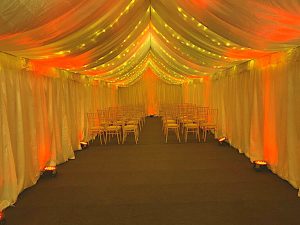
Because a tent can be erected using flexible materials, it is possible to ‘think outside the box’ and collaborate with the event planners or wedding organizers beforehand, to erect a separate private tent for the ladies, the approach to which uses several winding walkways fashioned out of covered “tunnels” that are made from the marquee’s tent material.
 Bring to mind how an underpass works. Equally private like one, the entrance tunnel will be erected on the ground instead of under it.
This will ensure that there is no unauthorized entry to their private section.
The use of tented walkways (“tunnels”) that turn or wind at right-angles once, twice or more, will allow the main ladies’ party area, including its entrance, to be completely screened from any lurkers’ view.

Curtained gazebo for the bride
Finally, in order to maintain the privacy of a bride at all of her wedding events, especially if she observes full hijab (but many of her extended family members do not), it is pertinent to erect a private, curtained and covered gazebo – just for her and her husband to sit inside, at these events.
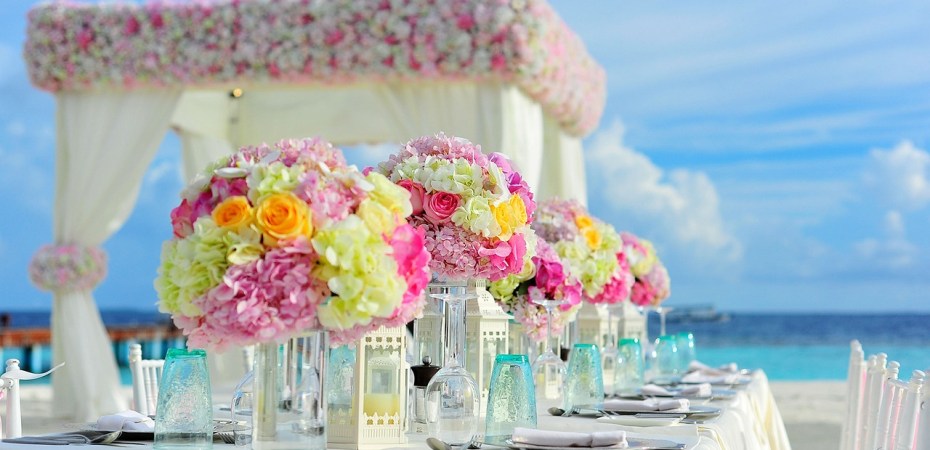
 Decorated with flowers, this small, private and secluded room inside the bigger event marquee can ensure that no one enters upon the bride, or tries to take her picture with their phone, without her prior approval and consent.
It is also relevant to mention here that covered marquees and gazebos can ensure privacy from cameras attached to drones flying overhead, which is yet another modern invention that is sadly being used in careless and irresponsible ways that impinge on others’ privacy – whether intentionally, or by mistake.
Finally, all Muslim women and girls who observe hijab, including a bride, should keep a light but broad scarf handy (i.e. within arm’s reach) at all times during parties and social events, just in case a non-mahrum man suddenly enters upon them without warning, or a stubborn older ‘aunty’ insists on taking their picture and refuses to take their ‘no’ for an answer. This scarf can quickly be draped over their heads to cover themselves in such a situation, – as a last but required resort.
Conclusion: consent and privacy are now serious legal issues, with implications
When it comes to matters related to privacy and consent, the modern world is undergoing a swift and dynamic change. With regard to personal boundaries that have to do with space and media, ‘consent’ has become a serious legal issue in many regions around the world, disregard of which can cause severe repercussions if taken lightly.
For maintaining and safeguarding Muslim women’s privacy, space, and modesty, consent becomes crucial. Even in the realm of digital photography and video-making, consent has become a legal requirement when filming and sharing any media online, which contains recognizable pictures of other people. This is what must be borne in mind when moving forward, as regards social events and digital photography.
Muslims should take the issue of privacy seriously, for the sake of obeying those laws and limits that Allah has set forth in the Qur’an and Prophetic narrations (ahadith). Many an A-list celebrity and power-playing influential figure today, such as politically powerful leaders, take elaborate measures beforehand to ensure the comfort, security and privacy of their guests when they convene a social event.
Guests might be asked to leave their phones at the entrance, with a special security team; filming and photography might be completely disallowed inside the event, and the trespassing of boundaries of priorly designated areas might be strictly prohibited, using guards, security pass-codes, and so on.
Even in this era of digital advancement, when it comes to drawing the line for the sake of privacy and security, many non-Muslims do not shy away from setting down the rules for guests when the latter enter their establishment, be it a swanky party venue, a place of recreation such as an exclusive club or retreat, or an office or workplace.
If people around the world can effectively take measures to guard the autonomy and privacy of their loved ones, why can’t we, – as Muslims – do the same for our mothers, sisters, wives, and daughters?
Why must we become lax when it comes to drawing the line to maintain boundaries that will allow our Muslim female-mahrum relatives and other sisters to dress up and thoroughly enjoy a social event – where they will be able to take off their hijabs and jilbaabs without an iota of worry or concern, and mingle freely with other women and children in a comfortable setting?
Where there is a will, as they say, there is always a way.
*****
Disclaimer: In addition to heterosexual adult males, it is obligatory for Muslim women to observe hijab from all those people who self-identify as “L”, “B”, “T”, “Q”, or “non-binary”. Castrated males and eunuchs are an exemption. And Allah knows best.
Discover more from Sadaf’s Space: From Blog to Books
Subscribe to get the latest posts sent to your email.

 Sadaf’s Space: From Blog to Books
“In the above verse (number 24) of Surah Al-Nur in the Qur’an, Allah exhorts all Muslim women to do what he has commanded Muslim men to do in the preceding verse of the same Surah (number 23) i.e. to lower their gazes and to guard their chastity.”
I thinks the bold parts is typed by mistake. It will be number 31 and number 30 respectivly.
Would you please check?
Jazak Allahu khairan katheera, brother, for pointing it out. I have rectified the mistake.